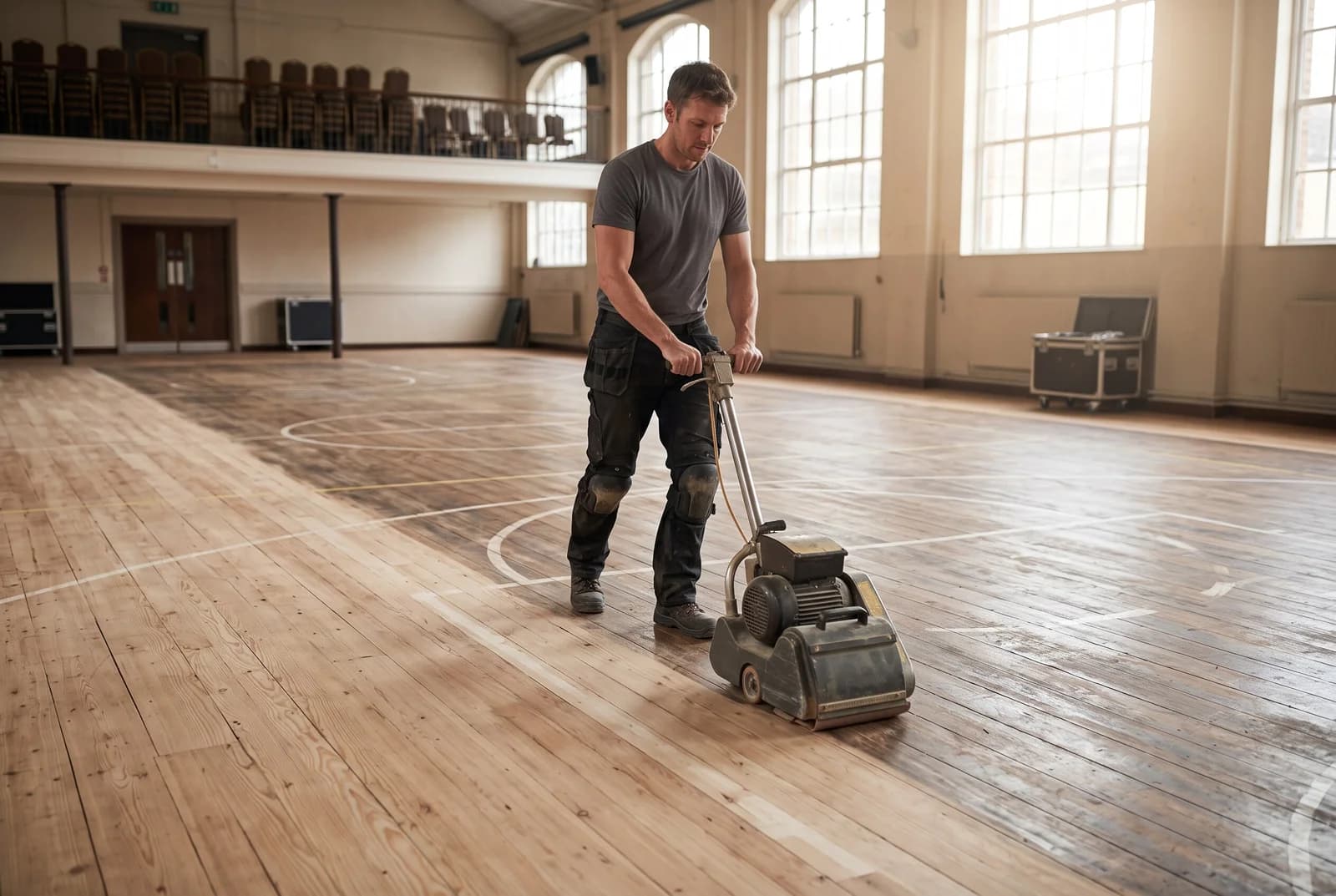
Assessing the condition of a timber court surface
Deciding between patching and replacement starts with a proper assessment, not just a glance at the finish. You need to understand what has happened to the playing surface, what may be occurring below it and whether the floor still provides consistent shock absorption, slip resistance and ball response. A visual inspection is useful, but it cannot always reveal moisture or subfloor problems.
Identifying wear, impact damage and moisture problems
Look first for worn coating, faded markings, dents, splintering, open joints and boards that sit higher or lower than their neighbours. Impact damage is usually local, while moisture-related problems may spread across a wider area and cause cupping, crowning, swelling or unusual gaps. Leaks, cleaning water and changes in indoor humidity should all be considered when the symptoms do not appear confined to one incident.
Small defects do not automatically mean the court has failed. However, a change in how the floor feels underfoot, a persistent squeak or movement across several boards deserves prompt attention rather than another coat of finish.
Checking the subfloor, joists and sports floor system
The visible timber is only one part of a sports floor. An inspection should consider the subfloor, joists, fixings, pads or other components in the sports floor system, as well as ventilation and moisture conditions. If movement originates below the boards, sanding the top surface may hide the symptom briefly without correcting the cause.
You should also compare affected areas with sound sections of the court. Differences in deflection, level or resilience can help a flooring specialist decide whether a local repair is technically sensible.
Distinguishing cosmetic defects from structural failure
A dull finish or light scuffing is generally a refinishing issue. A loose board, deep split or isolated dent may be repairable. By contrast, rot, widespread swelling, failed supports or substantial unevenness can indicate structural failure and should not be treated as a cosmetic problem.
The distinction matters because a smooth-looking surface is not necessarily a safe one. Safety comes before appearance when the court is used for repeated sprinting, jumping and changes of direction.
When to arrange a professional timber court inspection
Arrange an inspection when damage is spreading, repairs have not lasted, or users report inconsistent grip, bounce or movement. You should also seek advice after a leak, flood or prolonged period of excessive humidity. A useful survey records the condition of the surface and considers moisture, compliance needs, access and the operational timetable.
For a London venue, sports court refurbishment guidance can help you understand how sanding, plank replacement, line marking and EN14904 retesting may fit into a wider project. It is not a substitute for a site assessment, but it gives you a practical starting point.
When patching is the right repair
Patching is appropriate when the damage is limited and the rest of the timber court remains stable. The aim is to remove the failed material, match the replacement as closely as practical and blend the repaired area into the existing floor. Done well, a local repair can protect the surrounding boards and avoid unnecessary disruption.
The decision should still account for the finish, line markings and future sanding depth. A patch that looks acceptable in isolation may become more visible or wear differently if the broader surface is already near the end of its serviceable life.
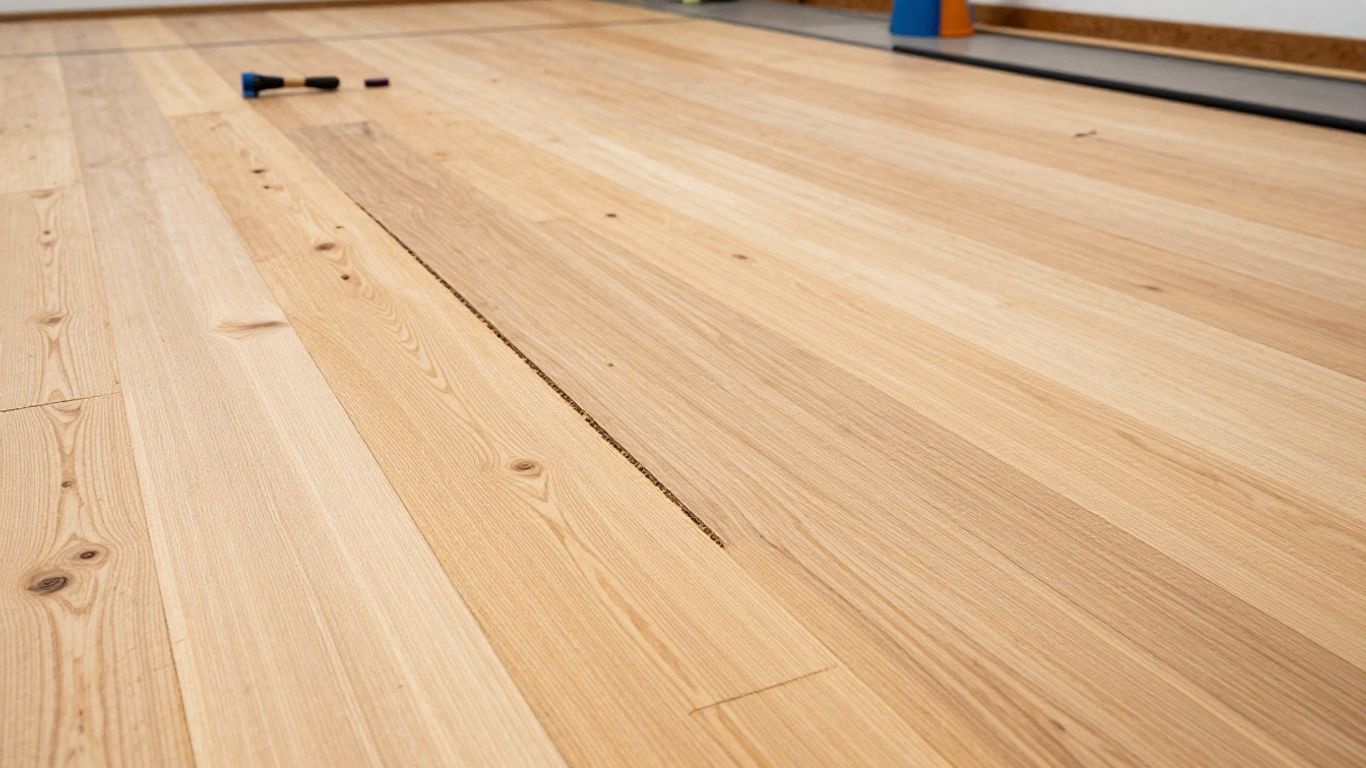
Small areas of localised damage
A few damaged boards caused by dropped equipment, a concentrated impact or a small isolated defect may be suitable for patching. The surrounding timber should be checked for movement, moisture and sound fixings before the repair is specified. If the cause has been addressed, a local intervention can restore a safe, even playing area.
The repaired section may then need sanding and recoating so that its texture and friction are compatible with the rest of the court. Colour matching is helpful, although an older floor may not accept a perfect visual match.
Replacing individual boards or damaged sections
Individual boards can sometimes be removed and replaced without disturbing the entire court. Larger affected sections may require a more carefully defined cut-out, replacement timber and levelling work around the edges. The new material must be suitable for the existing sports floor system and allowed to settle appropriately before finishing.
You should ask how the repair will interact with existing court lines. If markings cross the affected area, the quote should make clear whether they will be reinstated as part of the work.
Repairing gaps, splits and isolated dents
Minor gaps and dents can arise through normal use, seasonal movement or individual impacts. Filling and sanding may be suitable where the timber remains secure and the defect does not indicate moisture damage. Splits that are deep, active or close to a fixing need more careful assessment because filling alone may not provide a durable result.
A sensible repair sequence deals with the defect first, then prepares the surrounding surface for compatible sealing. This avoids leaving a visibly smooth patch beside a worn, poorly bonded finish.
Limits of patch repairs on heavily worn courts
Patching becomes less attractive when damage is scattered across the playing area or when the court has already been sanded several times. Multiple patches can create differences in colour, texture and wear, while repeated local work may cost more than a coordinated refurbishment.
Use the following practical signs as a prompt to reassess the whole surface rather than authorising another isolated repair:
- Several unrelated areas need attention at the same time.
- The finish is thin, flaking or worn through across traffic lanes.
- Gaps or movement return after previous repairs.
- Line markings and surface friction are inconsistent.
These signs do not automatically require a new floor, but they suggest that a broader survey and lifecycle comparison would be more useful than patching by habit.
When a timber surface needs replacement
Replacement is generally considered when the floor system cannot reliably provide a safe, even and durable playing surface. That may mean replacing a defined section rather than every board, depending on the extent and location of the damage. The key is to identify whether sound timber and supporting components can be retained without compromising performance.
A complete new floor is a major project for any London venue. It should be considered alongside partial replacement, refurbishment and the expected demands placed on the court over the coming years.
Widespread movement, rot or water damage
Widespread movement, rot and water damage are serious warning signs. Timber may swell, deform or lose strength, while moisture can also affect components beneath the surface. Drying the area and resolving the source of water must come before deciding what can be saved.
Where damage is extensive, replacing only the most obvious boards may leave hidden weakness nearby. A specialist should define the affected area and explain whether the existing sports floor system can be retained.
Repeated repairs in the same areas
If the same locations fail repeatedly, the original cause may not have been resolved. It could be movement below the boards, moisture, unsuitable previous materials or a section exposed to unusually heavy use. A repair history is therefore valuable when you commission a new assessment.
Repeated call-outs also have an operational cost. Even when each individual repair seems modest, recurring closures and inconsistent playing conditions can make a larger intervention more sensible.
Unevenness that affects player safety and ball response
Uneven boards, ridges and depressions can change how players plant their feet and how the ball travels. On a multi-sport court, even small variations may be noticed during fast play. If levelling and sanding cannot restore a consistent plane without removing too much usable timber, replacement becomes a more credible option.
The assessment should consider the intended sports, the existing performance requirements and the condition of the supporting system. A visually attractive floor still needs predictable underfoot behaviour.
Comparing partial replacement with a complete new floor
Partial replacement can preserve sound areas and reduce waste, but it requires a clear boundary between old and new work. A complete new floor offers greater consistency, although it normally involves more materials, preparation and downtime. Your decision should be based on condition, expected use and the cost of keeping the venue operational.
A useful comparison separates immediate work from longer-term consequences:
| Option | Usually suits | Main benefit | Main caution |
|---|---|---|---|
| Local patch | Isolated damage | Limited intervention | May not match an aged surface |
| Section replacement | Defined widespread damage | Retains sound areas | Boundary and level need careful detailing |
| Full replacement | Systemic failure or end-of-life floor | Consistent new surface | Higher cost and longer planning period |
The table is a starting point, not a specification. A site survey should confirm what lies below the timber and whether the proposed approach can meet the facility’s performance and compliance requirements.
What timber court refinishing involves
Refinishing is more than making a court look brighter. It prepares the existing timber, removes worn coatings, addresses suitable minor defects and applies a new sports-grade finish. The scope depends on the condition of the boards, the depth available for sanding and the performance standard required by the venue.
Complete Sports Flooring describes its refurbishment work as including dustless sanding, plank replacement, precise line marking and durable finish coats, with EN14904 retesting at handover where required. Those elements should be clearly identified in your quotation so you can compare like with like.
Sanding and levelling the existing surface
Sanding removes the old coating and smooths small variations in the timber. It must be controlled carefully: too little preparation can leave poor adhesion, while excessive sanding can reduce the usable life of the boards. Levelling is intended to create a consistent surface without disguising movement or structural defects.
Dustless equipment can reduce the impact on adjacent areas, though the venue will still need a properly isolated work zone and a realistic cleaning plan before reopening.
Filling joints, cracks and minor imperfections
Once the surface is prepared, suitable joints, cracks and minor imperfections can be filled where the timber is otherwise sound. Flexible movement and active moisture problems should not simply be sealed over. The repair material, preparation method and curing requirements all affect how well the finish performs.
You should expect the contractor to explain which defects are included and which would require board or section replacement. Clear boundaries prevent a refinishing quote from becoming an unexpected structural repair bill.
Applying sports-grade sealers and line markings
The finish needs to suit indoor sports use, cleaning routines and the required surface characteristics. Line markings should be accurate, durable and coordinated with the sports played at the venue. If you are updating a multi-sport layout, refinishing is a practical time to review the marking plan before the final coats are applied.
Water-based and oil-modified polyurethane finishes can have different curing characteristics. The appropriate choice depends on the project requirements, timetable and advice from the flooring specialist rather than appearance alone.
Allowing adequate curing and reopening time
A court is not ready simply because the final coat looks dry. Curing time, ventilation, temperature and humidity can affect when the surface is suitable for normal sports use. Your reopening plan should allow for inspections, line-marking completion, cleaning and any required testing.
Ask for the expected return-to-use date in writing, along with any restrictions on footwear, cleaning or early loading. A cautious handover protects the new finish and reduces the risk of premature wear.
Choosing a refinishing approach in London
London venues face practical constraints as well as technical ones. Schools may have narrow holiday windows, leisure centres may need to maintain bookings and commercial facilities may have difficult access or limited storage. A good refinishing plan deals with the floor and the building around it.
You should also consider the court’s sports, user groups, cleaning regime and compliance obligations. These details influence the specification and help prevent an attractive but unsuitable finish from being selected.
Selecting timber suitable for indoor sports use
Replacement boards should be compatible with the existing floor in dimension, stability and intended use. The choice of timber and fixing method can affect movement, appearance and the transition between repaired and retained areas. Your contractor should explain how the selected material will work within the existing sports floor system.
Do not treat a domestic flooring product as an automatic substitute for a sports surface. Indoor courts need a specification that supports repeated athletic use and consistent maintenance.
Meeting safety, performance and facility requirements
The specification should address shock absorption, slip resistance, surface friction, level and line-marking accuracy, alongside the relevant facility requirements. EN14904 may apply to indoor sports surfaces, but the exact assessment and handover requirements should be agreed for your venue and use.
Complete Sports Flooring works with schools, leisure centres and clubs on EN14904-compliant sports hall flooring and refurbishment projects. Its documented approach includes assessment and retesting where specified, which is relevant when you need a clear record at handover.
Planning work around schools, clubs and commercial venues
For a school or college, the summer holiday may provide the best working window, but access dates can become tight quickly. Clubs and commercial operators may instead need phased closures or evening planning, subject to noise, ventilation and curing requirements. Confirm who will move equipment, protect adjacent spaces and manage access before work begins.
A written programme should show preparation, repairs, sanding, coating, markings, testing and handover. It should also identify what happens if concealed damage is found after the surface is opened.
Accounting for access, ventilation and site conditions
Loading restrictions, stairs, parking controls and distance from the entrance can affect labour and programme time. Ventilation matters during coating and curing, while the building’s temperature and humidity may need monitoring. In central and inner London, delivery planning can be as important as the sanding itself.
A local specialist will usually ask for photographs, site access details and the court’s available closure dates before finalising the method. That early conversation can prevent avoidable delays.
Comparing the costs and long-term value
The cheapest initial option is not always the least expensive decision over the life of the court. Patching may reduce immediate downtime, while refinishing can renew a broader surface without the cost of a complete new installation. Replacement becomes more attractive when ongoing repairs are consuming budget and management time.
Request an itemised quotation that separates preparation, board replacement, repairs, coatings, line marking, testing, access arrangements and any provisional sums. This makes it easier to understand what you are actually comparing.
Factors that affect patching and refinishing prices
Price is influenced by the affected area, the number of boards, the condition of the coating, access, working hours and the finish selected. Moisture testing, subfloor repairs, line-marking changes and compliance testing may also affect the total. A survey is more useful than a rate based only on court size.
For context, Complete Sports Flooring presents refurbishment as a cost-effective alternative to full replacement and offers itemised quotes following a free on-site survey. You should still ask for the assumptions behind any quoted price and check whether VAT, protection and disposal are included.
When replacement offers better lifecycle value
Replacement may offer better value when a court has widespread movement, limited remaining sanding depth or a history of recurring failures. It can also make sense where the existing layout, support system or performance no longer suits the venue’s use. The calculation should include future maintenance, likely closures and the risk of another major repair.
A sound retained floor with a well-defined damaged section may still favour partial replacement. The right answer depends on evidence, not on a preference for either the smaller or larger project.
Balancing downtime against the cost of future repairs
Downtime affects lesson timetables, memberships, bookings and competitions. A short patch may appear attractive if a venue has only a few days available, but repeated interruptions can cost more than a planned refurbishment during a longer closure. Conversely, a complete replacement is difficult to justify if the remaining floor is stable and the defect is genuinely isolated.
Build both the programme and the financial impact into your comparison. Ask what work can be completed in one closure and what risks remain if you choose the minimum intervention.
Questions to ask a timber court refinishing contractor
Before appointing a contractor, ask questions that reveal how thoroughly the floor has been assessed and how clearly the work is defined. The answers should be specific to your court rather than copied from a general service description.
Useful questions include:
- What evidence shows that patching or refinishing is suitable?
- Will you inspect moisture, subfloor movement and supporting components?
- Which repairs, coatings, markings and tests are included in the quotation?
- How long will the venue remain closed, including curing and handover time?
- What maintenance guidance and warranty documentation will you provide?
The contractor should be able to explain the recommendation in plain language and identify any assumptions. That gives you a stronger basis for approving work and planning the court’s next maintenance cycle.
Conclusion
Court Refinishing: When to Patch and When to Replace a Timber Surface is ultimately a condition-based decision. If the damage is isolated and the floor system remains stable, a carefully prepared patch or refurbishment may restore performance; if movement, moisture or repeated failure is widespread, replacement deserves serious consideration. Arrange a detailed survey, compare the whole-life cost and plan the work around your users, compliance needs and closure dates.
—Quick answers
Frequently asked questions
Patching is usually considered for isolated damage in an otherwise stable floor. Replacement becomes more likely when movement, rot, moisture damage, unevenness or repeated failures affect wider areas or the supporting system.
Often, yes, provided the surrounding boards and subfloor are sound. The replacement must be compatible with the existing floor, properly levelled and finished so that it does not create a change in playing conditions.
No. Small seasonal gaps can occur naturally, but large, worsening or hazardous gaps may indicate humidity imbalance, shrinkage or another underlying issue. Their size, location and effect on play should be assessed.
The duration depends on preparation, repairs, coatings, markings, access and curing conditions. Your contractor should provide a programme that includes the full closure period, not just the sanding days.
Usually not. The finish needs adequate curing time, and the required period varies with the product and site conditions. Follow the contractor’s written reopening and cleaning guidance.
It can restore a more consistent, level and suitably finished surface when the underlying floor is sound. It cannot correct serious subfloor failure or concealed moisture without additional repair work.
It should consider the visible timber, coating, joints, moisture, level, movement, supporting components, line markings, access and the venue’s intended sports use. The findings should lead to a clearly itemised repair or replacement recommendation.