
Project overview: transforming a multi-sports facility in Richmond-upon-Thames
When you manage a multi-sports facility, the floor has to support far more than one type of activity. It needs to cope with repeated impact, changing footwear, equipment movement and frequent cleaning, often while the venue remains central to the local community. This Project Spotlight: Transforming a Multi-Sports Facility in Richmond-upon-Thames follows the practical decisions involved in renewing a shared-use sports floor.
The facility’s role in the local sporting community
A sports hall may serve school lessons in the morning, clubs in the evening and community sessions at weekends. That mixture makes the condition of the floor visible to a wide range of users, from young players learning basic movement to experienced teams expecting a predictable surface. For a facility manager, the floor is therefore part of the venue’s reputation as well as its infrastructure.
Local investment in active spaces can also widen participation, provided the venue is safe, welcoming and affordable to operate. You can explore broader context around community activity through London active spaces, while keeping the flooring decision focused on the particular building, programme and budget in front of you.
The demands placed on a shared-use sports floor
A shared floor must provide suitable friction without feeling harsh underfoot. It also needs consistent ball response, adequate shock absorption and a finish that can tolerate regular use without becoming difficult to clean. Basketball, badminton, volleyball, indoor football and general fitness activities may all place different demands on the same area.
The answer is rarely a single isolated specification. You have to consider the subfloor, timber or synthetic surface, sports equipment, cleaning regime and the number of hours the facility operates each week. That is why a survey-led approach is more useful than choosing a coating from appearance alone.
Signs that refinishing was the right solution
Refinishing becomes attractive when the underlying floor remains serviceable but the top surface has become dull, worn or uneven. Scratches, embedded residue, local dents and faded markings can make a hall look tired, yet they do not automatically mean that every board or section needs replacing. A closer inspection separates cosmetic wear from structural problems.
Complete Sports Flooring provides sports hall sanding, refinishing and refurbishment services in Richmond upon Thames, including a free on-site survey and itemised quote. That process gives you a clearer basis for comparing refurbishment with more disruptive full replacement work.
Project objectives for performance, safety and appearance
The project objective was not simply to make the hall look newer. You would want a surface that feels consistent across the playing area, supports the intended activities and can be maintained without excessive downtime. Compliance considerations, including EN14904 where applicable, also need to be addressed through the specification and final checks.
A successful brief usually balances four things: user safety, sporting performance, visual quality and operational practicality. When those priorities are agreed at the outset, decisions about repairs, coating, markings and reopening become much easier to manage.
Assessing the existing sports floor
Before any sanding begins, you need a reliable picture of what is already there. The assessment should cover visible wear, hidden causes of movement, moisture risk and the way the floor behaves during use. This is the point at which an apparently straightforward refinishing job can be properly scoped rather than guessed.
Checking surface wear, damage and contamination
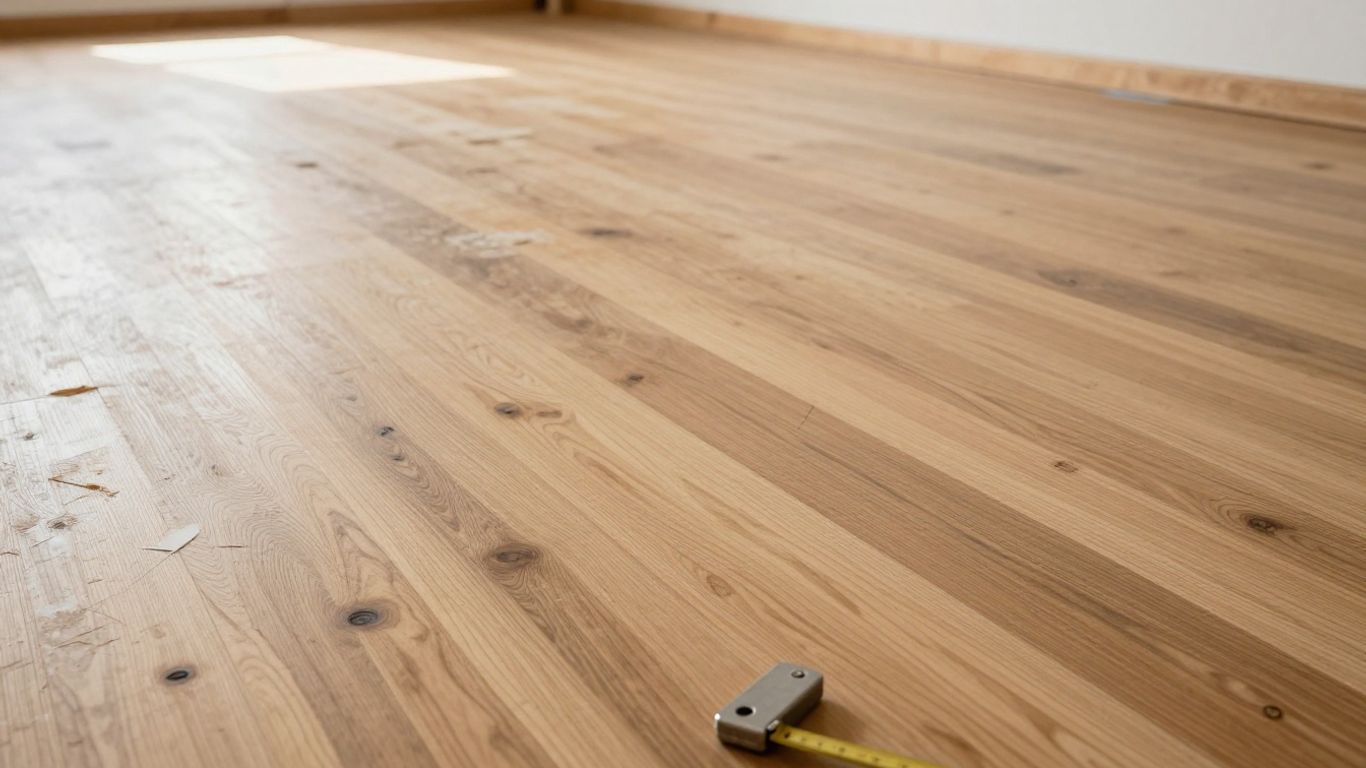
Start by looking across the floor in good light, then inspect high-traffic areas, entrances, equipment zones and places where furniture or goals are regularly moved. Old polish, rubber transfer, adhesive and cleaning residue can affect how a new coating bonds. Small defects may also become more noticeable once the surface is cleaned and stripped.
You should record the location and character of each issue, rather than relying on a general impression. Photographs, measurements and notes about previous repairs help create a practical schedule of works and make the quotation easier to understand.
Identifying areas affected by moisture or movement
Moisture testing and an examination of joints can reveal problems that a visual inspection misses. Boards that have cupped, gapped or moved may point to environmental changes, subfloor conditions or localised water exposure. Those causes need attention before the final finish is applied.
Movement is also relevant to user experience. A floor that looks acceptable but responds differently from one area to another may affect confidence and play. Any remedial work should therefore be based on the observed condition, not just the age of the surface.
Evaluating grip, ball response and shock absorption
Your assessment should consider how the floor performs during the activities it hosts. Excessive slipperiness, inconsistent friction or a noticeably dead area can be more significant than light surface marking. If the floor is used for impact sports, shock absorption and area elasticity deserve particular attention.
The observations can then be compared with the facility’s requirements and relevant guidance. A finish that looks attractive but changes grip or ball response in an unsuitable way is not a successful refurbishment, however neat the final appearance may be.
Deciding between refinishing, repairs and full replacement
The decision should weigh the condition of the surface against the state of the boards, subfloor and supporting system. Refinishing may be sensible where wear is mainly within the coating, while local repairs can address isolated damage. Full replacement becomes more appropriate when deterioration is widespread or the existing construction cannot deliver the required performance.
A clear comparison helps you explain the recommendation to governors, trustees, owners or procurement teams. It should include scope, expected disruption, compliance checks and future maintenance, not just the initial price.
| Option | Best suited to | Main planning consideration |
|---|---|---|
| Refinishing | Sound floor with worn coating | Careful preparation and curing time |
| Local repairs and refinishing | Isolated dents, joints or damaged boards | Matching repairs to the existing floor |
| Full replacement | Extensive structural or performance failure | Greater cost, design work and disruption |
The table is a useful starting point, but the final recommendation still depends on the site survey. A measured decision can prevent you from replacing a recoverable floor or coating over a defect that will return.
Preparing the floor for refinishing
Preparation determines whether the new finish looks even and performs as intended. It involves more than passing a sander over the playing area: old residues must be removed, repairs completed and the surface left clean enough to receive the next system. You also need a plan for keeping people, equipment and dust away from the work zone.
Removing old coatings and built-up residue
The existing coating is removed in stages appropriate to its condition and the floor construction. Areas near walls, thresholds and fixed equipment often need additional care because residue collects in edges and corners. Any contamination left behind can affect adhesion, appearance and the consistency of the final sheen.
You should also agree how adjacent spaces will be protected before work starts. Good preparation reduces rework and helps keep the refurbishment within the closure period agreed with the venue.
Repairing joints, dents, cracks and localised damage
Once the old finish has been removed, defects are easier to assess. Damaged boards may require replacement, while smaller dents, open joints or cracks may be suitable for local repair. The repair material and method need to be compatible with the floor so that the affected area does not remain visibly or mechanically different.
Repairs should be allowed to settle before final sanding. Rushing this stage can leave ridges, depressions or movement that become obvious after the new coating has cured.
Sanding to create an even, receptive surface
Sanding progressively removes remaining finish and blends repaired areas into the surrounding floor. The aim is a uniform, level surface with an appropriate key for the primer or coating, not simply a pale appearance. Edges and transitions require the same attention as the centre of the court.
Dustless equipment can make the process easier to control in an operating school, leisure centre or club. Complete Sports Flooring describes dustless equipment as part of its Richmond sports hall refurbishment process, helping minimise disruption while the surface is prepared.
Managing dust, access and safeguarding requirements
Before the work begins, you should define delivery routes, restricted areas, emergency access and arrangements for staff, pupils and visitors. A sports hall may be attached to classrooms, changing rooms or public circulation routes, so isolation needs to be practical as well as secure. Cleaning and ventilation plans should be agreed with the contractor and the venue team.
A short, well-managed closure is usually easier for everyone than repeated partial access. Keep the communication simple: explain what is closed, when it will reopen and what signs will confirm that the surface is ready for use.
Selecting a finish for a multi-sports environment
The finish affects how the floor looks, feels and behaves under repeated use. It should be chosen alongside the sports schedule, cleaning products, ventilation arrangements and the required reopening date. You are selecting a working surface, not merely a decorative top layer.
Balancing durability with player comfort
A durable finish must withstand foot traffic, equipment and routine cleaning, but excessive hardness or an unsuitable friction level can affect comfort. The right balance depends on the floor system and its users. You should consider both the intensity of activity and the age range of the people using the hall.
A finish that remains consistent over time is generally more valuable than one chosen only for a striking initial appearance. The specification should explain the expected use and the maintenance conditions that support it.
Choosing slip resistance for different sporting activities
Different sports call for predictable traction during starts, stops, turns and landings. Too little grip can undermine confidence, while too much can increase stress on joints and footwear. The choice should be tested against the facility’s principal activities rather than judged by touch in an empty hall.
Where several sports share one surface, you may need to prioritise a balanced performance across the programme. Clear communication with coaches and users can help identify whether the current floor’s behaviour is a genuine problem or simply a difference in expectation.
Considering low-odour and low-emission coating options
Odour and curing time matter particularly when a hall sits within a school or busy leisure building. Water-based systems may be recommended for schools and leisure centres because the documented advantages include faster cure time and lower VOCs. The final selection still needs to match the floor, programme and manufacturer’s application requirements.
Ventilation should be planned rather than improvised. Even a lower-odour product needs appropriate handling, curing time and protection from premature traffic.
Matching the specification to cleaning and maintenance routines
A finish will only retain its intended performance if the cleaning regime is compatible with it. Review the products, machines, water levels and frequency used by the venue team before finalising the specification. This avoids handing over a newly refinished floor with instructions that are unrealistic for daily operations.
The maintenance plan should also state how to deal with scuffs, spills and equipment marks. Simple, clear guidance makes it more likely that the surface will be cared for consistently after the project team has left.
Delivering the refinishing work in Richmond-upon-Thames
Delivery is where the technical specification meets the practical reality of a live venue. In Richmond-upon-Thames, access, parking, deliveries and closure dates all need to be considered early. A well-sequenced project protects the finish while reducing the effect on lessons, bookings and community sessions.
Planning the work around the facility’s operating schedule
You should map the venue’s timetable before agreeing dates, including exams, tournaments, holiday clubs and maintenance periods. School holidays can provide a useful closure window, but only if materials, labour and inspections are coordinated in advance. Contingency time is sensible where curing or access could be affected.
Complete Sports Flooring works around facility schedules, including school holidays, and its Richmond service information describes a free on-site survey before an itemised quote. That kind of early planning gives you a clearer route from initial inspection to handover.
Applying primers, coatings and sealers consistently
Application needs an orderly sequence, suitable equipment and careful attention to coverage. Edges, repaired sections and transitions should receive the same treatment as the open playing area. Consistency in film build and overlap helps avoid visible variation in sheen or texture.
The work should follow the agreed product system and application instructions. If conditions change, the team should record the issue and adjust the programme rather than compromising the finish.
Controlling curing times, temperature and ventilation
Curing is part of the project, not an administrative gap between application and reopening. Temperature, humidity, airflow and traffic can all affect when the floor is ready. You should protect the surface from dust, moisture and accidental use while it reaches the required condition.
Build curing time into communications with staff and users. Promising an early reopening before the surface is ready can create avoidable damage and extend the disruption you were trying to reduce.
Carrying out quality checks before reopening the venue
Before handover, inspect the whole floor for missed areas, coating defects, visible repairs and marking quality. Check that doors, equipment and access routes can be used without damaging the new surface. Where required, retesting and documentation should form part of the close-out process.
Complete Sports Flooring states that its Richmond refurbishment service includes an EN14904 retest and warranty upon completion. For you as a facility manager, the value lies in receiving clear records that support both operational sign-off and future maintenance decisions.
Re-marking the floor for multiple sports
Line marking is one of the most visible parts of the finished project, and accuracy matters as much as colour. A shared hall may contain several overlapping layouts, each needing to remain legible without making the surface look confusing. The marking plan should be agreed before application begins.
Planning accurate layouts for each court and activity
Begin with verified dimensions and a drawing of the proposed layouts. Consider run-off areas, posts, goals, access points and any fixed equipment that affects how the courts will be used. It is easier to resolve a conflict on paper than after paint has been applied.
You should also confirm which sports are essential and which are occasional. This helps keep the most frequently used lines prominent while ensuring less common activities are still correctly accommodated.
Coordinating colours, line widths and visual clarity
Colour selection should create enough contrast with the floor and with neighbouring markings. Line widths need to be consistent, and the overall palette should be easy to interpret under the venue’s lighting. Too many similar tones can make boundaries difficult to read during fast play.
Discuss the scheme with staff before final approval. A floor can be technically accurate and still feel visually busy if every line is given equal emphasis without considering how users navigate the space.
Avoiding conflicts between overlapping court markings
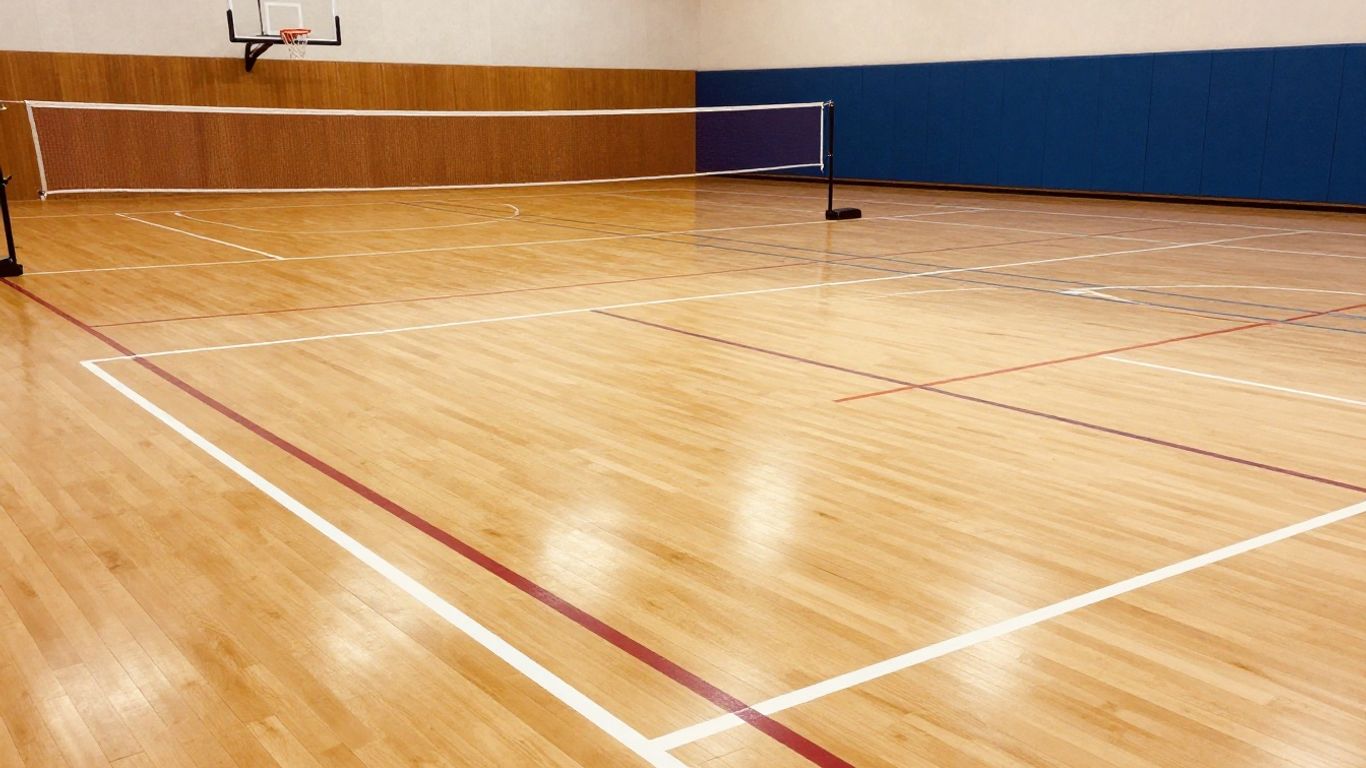
Overlapping lines are unavoidable in many multi-sports halls, but they should not obscure key boundaries. The layout can use carefully selected colours and a clear hierarchy to distinguish the main court from secondary activities. Equipment storage and changing use may also influence which orientations work best.
Where new activities are being added, such as pickleball or wheelchair basketball, check the proposed lines against the existing layouts. A coordinated drawing prevents late changes and reduces the risk of unnecessary repainting.
Verifying measurements and compliance before handover
A final measurement check should confirm court dimensions, line widths, intersections and the position of relevant equipment. Walk the floor from the perspective of a player and an official, looking for places where markings become difficult to follow. Record the approved layout for future maintenance or re-marking.
The handover should bring together the floor specification, care instructions, inspection notes and any compliance documentation. That record gives you a dependable reference when the hall next needs attention.
The results and long-term value of the project
A sports floor refurbishment is successful when the improvement remains useful after the initial reveal. The visual change matters, but so do predictable movement, manageable maintenance and a reopening plan that has not disrupted the venue unnecessarily. Long-term value comes from treating the floor as an operational asset.
Improving appearance and first impressions
A clean, even surface with crisp markings changes how users experience the hall as soon as they enter. It can make the venue feel better cared for and give visiting teams greater confidence in the facilities. For schools and leisure centres, that first impression can influence how comfortably people return and recommend the space.
The appearance should remain tied to performance, though. A polished surface is only a worthwhile result when the preparation and finish also suit the activities taking place on it.
Supporting safer, more consistent play
Consistent grip, ball response and shock absorption help users move with greater confidence. They do not remove every risk associated with sport, but they support a more predictable playing environment when combined with suitable footwear, supervision and housekeeping. Regular inspections remain necessary after handover.
You can also use the completed assessment as a baseline. Comparing future wear with the original condition makes it easier to identify developing issues before they become a larger interruption.
Reducing disruption through a planned refurbishment
Refinishing can be a practical alternative to full replacement when the existing floor is fundamentally sound. Complete Sports Flooring describes court refinishing as a cost-effective refurbishment route and states that projects can typically be completed in 5–10 days, although your actual programme will depend on the floor, repairs and curing requirements.
The benefit is not simply a shorter closure. Retaining a serviceable floor can reduce waste, limit changes to surrounding areas and allow you to direct budget towards other facility priorities.
Protecting the refinished floor with an ongoing care plan
The handover should include a realistic cleaning and maintenance routine, along with advice on dealing with spills, marks and equipment. Use entrance matting where practical, lift rather than drag heavy items and keep unsuitable chemicals away from the surface. Small habits often have a larger effect than occasional intensive cleaning.
Schedule inspections around the venue’s calendar and respond to early wear. A mid-life sand-and-recoat may be recommended around year 12, but the appropriate timing depends on usage and condition. With consistent care, you can protect the refinished surface and plan future closures instead of reacting to sudden failure.
Conclusion
For a busy Richmond-upon-Thames venue, sports floor refinishing is a considered process rather than a quick cosmetic refresh. By surveying the existing floor, preparing it properly, choosing a suitable finish, re-marking accurately and planning maintenance, you can improve the playing environment while keeping disruption under control.
—Quick answers
Frequently asked questions
Many projects can be completed within a planned closure of around 5–10 days, but the exact duration depends on the floor condition, repairs, coating system, curing time and access arrangements.
Refinishing can be suitable when the underlying floor remains sound and the main problems are worn coatings, local damage or faded markings. Replacement may be necessary where structural or performance issues are widespread.
A survey should review surface wear, contamination, joints, moisture, movement, repairs, playing performance, existing markings and the operational requirements of the venue.
The finish should match the floor construction, sports programme, required friction, durability expectations, cleaning routine, ventilation and reopening schedule. There is no single product that suits every hall.
Yes, provided the floor system and finish are appropriate and the court layouts are planned carefully. Accurate, contrasting markings help users distinguish overlapping activities.
Agree dates around closures or school holidays, confirm access and deliveries early, protect adjacent areas and allow sufficient curing time before bringing equipment and users back into the hall.
Follow the recommended cleaning method, remove spills promptly, avoid dragging equipment, protect entrance areas and arrange periodic inspections so early wear can be addressed before it spreads.