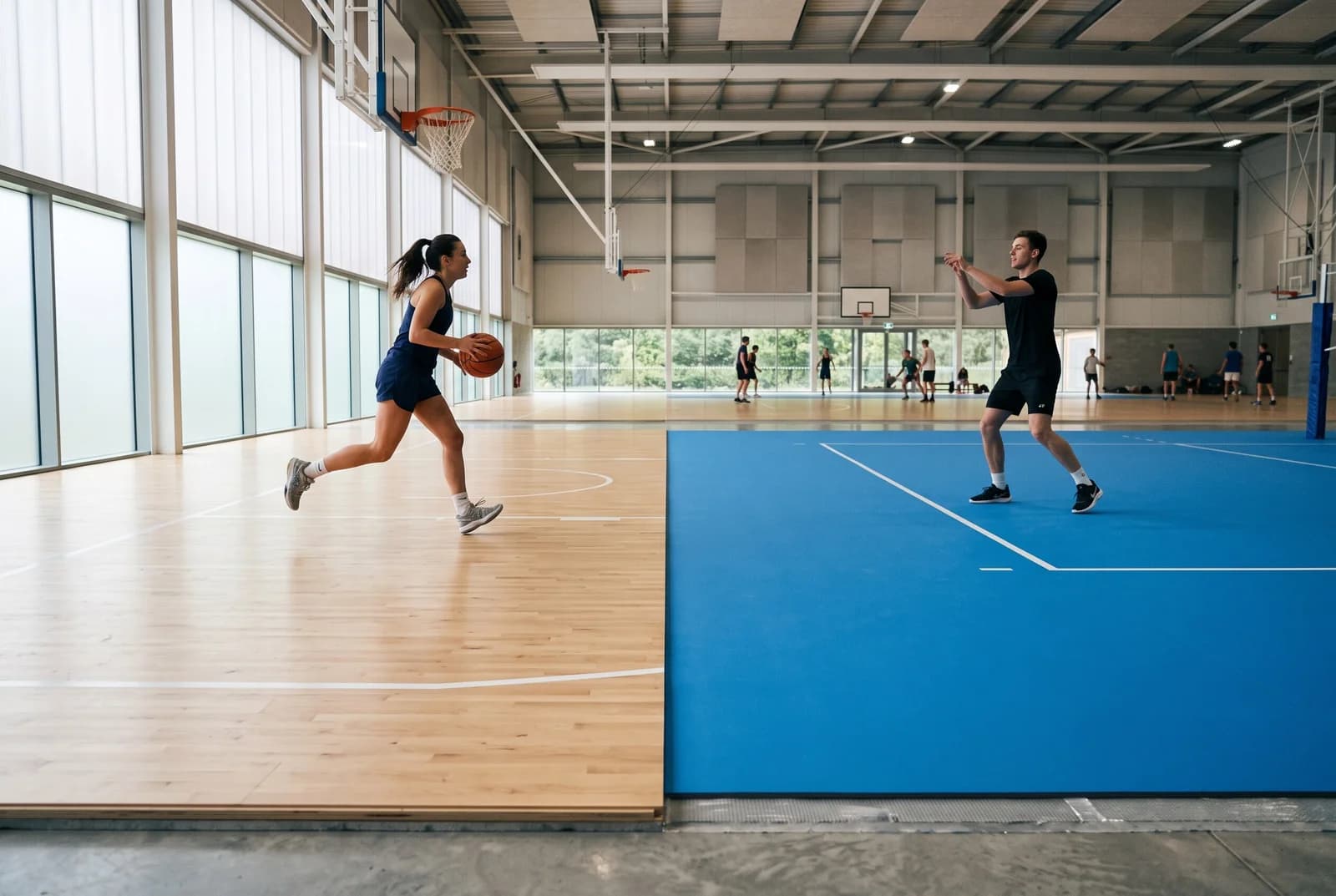
Compare the construction of solid timber and area-elastic synthetic floors
The visible finish is only one part of a sports floor. Underneath it, the support system determines how impact is absorbed, how the ball behaves and how evenly the surface responds. Solid timber and synthetic floors can both be designed as area-elastic systems, but they achieve that response through different materials and construction methods. For a useful comparison, you need to assess the complete build-up rather than the top layer alone.
How solid timber sports floors are built
A solid timber sports floor normally combines a hardwood playing surface with a sprung or resilient subfloor. The timber boards sit above battens, pads, beams or another engineered support arrangement, allowing the floor to deflect over a broader area when a player lands. The boards are then sanded, sealed and marked for the sports the hall will host.
This construction gives you a natural-looking court with a consistent playing character, but it also demands careful detailing. Board movement, ventilation, moisture levels and expansion allowances all need to be considered. The final result depends on the relationship between the hardwood, the supporting system and the base slab.
How area-elastic synthetic systems distribute impact
An area-elastic synthetic system uses a resilient supporting structure beneath a continuous surface such as vinyl, polyurethane or another sports-grade finish. When an athlete lands, the force is distributed across a wider section of the floor instead of being absorbed only at the precise contact point. That can provide a stable feel across a multi-use area while allowing the finish to be tailored to the specification.
The synthetic layer is not automatically softer or safer simply because it is synthetic. Its behaviour comes from the whole system, including the thickness and resilience of the surface, the sprung construction and the stiffness of the base. You should therefore ask for tested performance data for the complete floor assembly.
The difference between area-elastic and point-elastic performance
Area-elastic floors deflect across a wider zone around an impact. Point-elastic floors absorb more of the force directly beneath the foot or landing point, often through a resilient foam-backed finish. A combined system uses characteristics of both, so the distinction affects shock absorption, rolling resistance, ball response and accessibility.
The choice should reflect the activity rather than a general preference for one material. A useful comparison of elastic sports flooring systems explains how area, point and mixed elastic approaches differ in comfort, vertical deformation and facility use. Those distinctions become particularly relevant when you are planning for wheelchair sports, frequent equipment movement or several court sports in one hall.
Why subfloor design affects the final result
Even an excellent surface can perform poorly if the subfloor is uneven, damp or inadequately supported. Your survey should examine the slab, moisture condition, levels, movement joints, access routes and any existing damage before the floor is selected. This is also where you establish whether the proposed system can meet the required performance classification.
For London schools and leisure facilities, a specialist assessment can help connect the technical specification with the building itself. Complete Sports Flooring provides sports hall flooring installation guidance covering EN14904-compliant systems, installation, maintenance and refurbishment. That kind of joined-up approach reduces the risk of choosing a surface that cannot perform as intended on the existing base.
Assess sports performance and user safety
A sports floor has to support movement without becoming unpredictable. You will be balancing shock absorption, deformation, friction, ball response and comfort, often for users with different abilities and playing styles. Compliance testing gives you a useful framework, but the chosen performance level still needs to suit the hall’s actual programme. Think about the busiest activities, not just the sport shown in the original design brief.
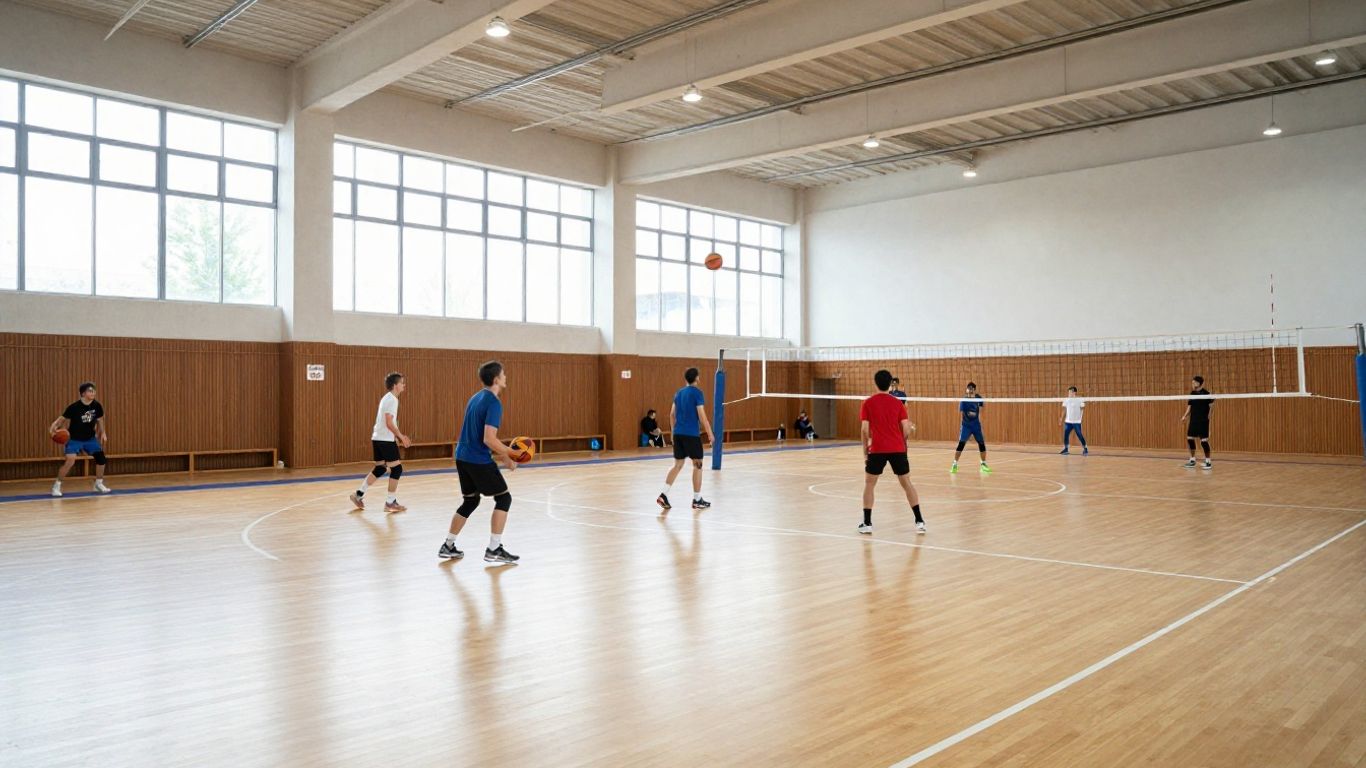
Shock absorption and force reduction
Shock absorption describes how much impact energy the floor reduces or dissipates. A well-specified area-elastic system can spread landing forces and make repeated running, jumping and stopping more comfortable. Too little force reduction may feel harsh, while excessive movement can make the surface feel slow or unstable.
You should compare declared test results for the entire installed system, not just a synthetic coating or timber species. EN14904 performance categories provide a useful reference for sports floors, but the result depends on installation as well as manufacture. Tested whole-system performance is more meaningful than a broad claim about a material.
Vertical deformation and ball response
Vertical deformation is the amount the floor moves under load. It affects how your feet feel during acceleration and landing, but it also influences how a basketball rebounds and how equipment rolls. A floor that feels comfortable to a player may still be unsuitable if it produces an inconsistent ball response across the court.
For basketball-led venues, court geometry, surface friction and game-line accuracy matter alongside cushioning. Complete Sports Flooring’s basketball court flooring service describes EN14904-compliant hardwood systems, FIBA-related requirements, subfloor preparation and precise line marking. You should ask for the expected ball response and tolerances for the installed specification rather than relying on a sample underfoot.
Slip resistance across different sports
Slip resistance needs to provide grip during changes of direction while still allowing controlled movement. The ideal feel varies between badminton, netball, basketball and indoor football, and contamination from dust or cleaning residue can change performance quickly. A glossy appearance is not a reliable guide to traction.
Your maintenance plan should state which cleaning products, pads and machines are suitable. It should also explain how the floor will be checked after installation and what happens if the playing characteristics change. Regular inspection is especially important in halls shared by schools, clubs and casual users.
Comfort, fatigue and injury-risk considerations
Comfort is shaped by the floor, footwear, training volume and the quality of the supporting subfloor. A resilient surface may reduce the harshness of repeated impacts, but it cannot remove injury risk or compensate for poor technique. You should consider users who spend long periods on court, including pupils, coaches, officials and wheelchair athletes.
Ask your installer to relate the specification to real sessions and traffic patterns. A facility used from early morning until late evening may need a different balance of resilience and durability from a lightly used community hall. The safest decision is usually the one supported by test evidence, competent installation and sensible operational care.
Match each surface to different sports and facility uses
The best sports hall surface is rarely chosen by material alone. You need to map the floor to the sports programme, equipment, user groups and events held in the space. Timber can suit a court-focused venue particularly well, while synthetic finishes may offer practical flexibility where the hall changes use several times a day. The correct answer can also vary between two buildings managed by the same organisation.
Basketball, netball and indoor football
Basketball places strong demands on ball rebound, friction, force reduction and line accuracy. A well-installed area-elastic timber system is often a strong fit for a dedicated or basketball-led court, particularly where competition performance and a traditional hardwood finish are priorities. Netball also benefits from predictable grip and controlled movement, while indoor football may place greater emphasis on resilience, cleaning and resistance to frequent foot traffic.
You should consider whether the hall is court-led or genuinely multi-purpose. A basketball flooring assessment can help a Southwark facility review its EN14904 requirements, area-elastic hardwood options and operational schedule before committing to a specification. The same survey-led process is useful elsewhere, even where basketball is only one part of the programme.
Badminton, volleyball and multi-sport halls
Badminton demands reliable foot placement and a surface that does not feel unexpectedly sticky or slippery. Volleyball brings repeated jumping and lateral movement, while a multi-sport hall must tolerate different shoes, layouts and equipment. In these settings, the supporting system and tested performance are more important than whether the finish is described as timber or synthetic.
A synthetic area-elastic surface may be attractive where you need a continuous, adaptable finish and straightforward visual coordination. Timber remains a sound option where court sports dominate and the facility can support its cleaning and refurbishment requirements. Compare the full schedule before deciding.
School, community and elite-performance environments
Schools often need a floor that survives intense daily use, timetable changes and occasional non-sport activity. Leisure centres may need to accommodate clubs, public sessions and competitions, while elite environments can place greater emphasis on repeatable performance and precise court conditions. Your budget should reflect these differences rather than applying one standard specification to every hall.
For a school or college, discuss term dates, storage, access and safeguarding alongside technical performance. For a professional venue, include event presentation, competition rules and planned maintenance windows. In every case, the installer should explain how the proposed system meets the relevant requirements without hiding important assumptions in the quotation.
Halls that host non-sport events
Many halls become examination spaces, meeting rooms, community venues or exhibition areas between sporting sessions. Heavy chairs, staging, wheeled equipment and spillages can challenge a delicate finish, so you need to assess indentation resistance and protection procedures. Area-elastic systems are often considered for their broad impact distribution, but the finish and event controls still matter.
Plan how furniture will be moved, where protective coverings will be stored and how quickly the hall must return to sport. If events are frequent, a slightly different surface choice may offer better whole-life value than a competition-focused floor that needs constant protection.
Compare durability, maintenance and lifespan
Durability is not simply a question of whether timber or synthetic material lasts longer. Usage intensity, cleaning discipline, footwear, sunlight, moisture, furniture and repair quality all influence the useful life of a sports floor. A surface that is easy to maintain but poorly installed can disappoint, just as a high-quality timber floor can suffer if it is cleaned incorrectly. You should compare the care plan at the same time as the product specification.

Resistance to wear, dents and surface damage
Timber can be marked by grit, concentrated loads and dragged equipment, although a properly maintained finish can be renewed. Synthetic surfaces resist some common forms of wear well, but they may be vulnerable to cuts, burns, indentation or localised damage depending on their construction. Neither option should be treated as indestructible.
Your assessment should include the busiest routes, entrances, goal areas and storage zones. Ask whether protective boards are required for events and whether castors, cleaning machines or temporary seating are compatible with the floor. These details often have a greater effect on longevity than small differences in the initial material cost.
Cleaning routines and ongoing care
Daily dust removal, prompt spill response and suitable damp cleaning are basic requirements for either system. The precise products and machine settings will vary, so you should follow the manufacturer’s instructions rather than using a general-purpose chemical. A planned inspection can identify worn coatings, open joints, contamination or areas where slip resistance is changing.
A written maintenance schedule should identify who carries out routine cleaning, when deeper cleaning is required and how defects are reported. It should also allow for closures at sensible intervals, so remedial work does not become an emergency during the busiest part of the season.
Repairing timber boards versus synthetic finishes
Timber can often be locally repaired and later sanded and recoated as part of a larger refurbishment. Damaged synthetic finishes may be patched, welded or recoated depending on the system, but colour and texture matching can be more visible. The feasibility of either approach depends on the extent of damage and whether the underlying support remains sound.
Before signing off a project, ask for a repair strategy and details of available replacement materials. Keep spare sections, finish references and as-built information where possible. That small amount of record-keeping can shorten future closures and prevent avoidable compatibility problems.
Expected service life and refurbishment cycles
There is no single service-life figure that applies to every sports hall. A lightly used school floor, a heavily booked leisure centre and an elite training venue will experience very different wear. Timber may require periodic sanding and recoating, whereas synthetic systems may need deep cleaning, local repairs or eventual replacement of the finish.
Treat refurbishment as part of the original asset plan. Complete Sports Flooring is a London-based specialist established in 1994, offering installation, refurbishment and maintenance support for educational and commercial facilities. The practical question is not only how long the floor lasts, but how easily you can keep it safe, presentable and compliant throughout that period.
Examine installation requirements and project disruption
Installation can be the point at which a sound design succeeds or fails. The existing slab, moisture condition, access, storage and environmental controls all affect the programme. You also need to protect other users, coordinate deliveries and decide how the hall will operate while the work is under way. A detailed site survey should precede any confident promise about dates or cost.
Subfloor preparation and moisture control
The subfloor must be clean, sufficiently level and suitable for the proposed build-up. Moisture testing is essential because trapped moisture can affect adhesives, timber movement, coatings and the long-term bond of a synthetic finish. Movement joints, cracks and local repairs should be recorded rather than concealed beneath the new floor.
Ask for the test method, acceptance limits and proposed remediation if readings are outside tolerance. You should also confirm who carries responsibility for making good the base and how any delay will be handled. These points belong in the scope of work, not in informal assumptions.
Installation times for timber and synthetic systems
Timber installation may involve subfloor preparation, resilient supports, board laying, sanding, sealing, curing and line marking. Synthetic systems can have a different sequence, including adhesive or poured layers and curing periods, so neither should be judged by the visible installation stage alone. Ventilation, temperature and access restrictions may affect when the hall can reopen.
For schools, work is often planned around holidays or other closures. Leisure centres may need phased access or carefully timed deliveries. Build a realistic allowance for testing, snagging and curing rather than planning to the last available day.
Floor markings, game lines and custom finishes
Accurate game lines are part of the playing surface, not an afterthought. You should confirm the sports, line colours, court orientation, logos and any zones that must remain clear before the finish is applied. On a shared hall, a carefully coordinated layout can prevent visual confusion and reduce future alterations.
The installation brief should include measurements, marking tolerances and approval of the final drawing. It should also state whether logos or custom colours affect lead times, cleaning methods or future repairs. Clear decisions early in the programme are usually cheaper than corrections after curing.
Underfloor heating, insulation and acoustic requirements
Heating, insulation and acoustics can influence the floor build-up and the building’s everyday comfort. Underfloor heating may affect moisture movement and material compatibility, while resilient supports can alter impact sound and room acoustics. These interfaces should be reviewed with the design team before the floor is ordered.
You may need coordinated details for thresholds, skirtings, doors, ventilation and accessible routes. A sports floor is part of the building, so the specification should not be isolated from the rest of the refurbishment. Early coordination helps avoid late changes that extend the closure.
Compare costs and whole-life value in 2026
The lowest tender price is rarely the same as the lowest cost over the floor’s useful life. Your comparison should include the complete build-up, preparation, markings, testing, protection, maintenance and likely refurbishment. Costs also vary with hall size, access, regional labour, specification and the condition of the existing base. For that reason, a site-specific quotation is more useful than a headline rate.
Initial supply and installation costs
Solid timber often carries a higher initial specification and installation requirement because of the hardwood surface, supporting structure and finishing stages. Synthetic systems can vary widely according to whether the finish is sheet, poured or layered, and according to the resilience required beneath it. Base repairs and access constraints can change either estimate substantially.
Request an itemised quotation that separates preparation, materials, installation, markings, testing and handover. This makes it easier to compare like with like and to identify whether a cheaper proposal has omitted important work. Complete Sports Flooring’s approach includes site assessment and tailored quotations, which is useful when you are working within a fixed capital budget.
Maintenance, refinishing and replacement expenses
Timber maintenance may include cleaning, recoating, local board repairs and periodic sanding. Synthetic maintenance may involve specialist cleaning, seam or surface repairs and eventual renewal of the finish. The right frequency depends on traffic and the manufacturer’s instructions, so avoid treating an indicative cycle as a guarantee.
Include labour, closure time and temporary arrangements in your forecast. A refurbishment that requires a longer shutdown may cost more operationally even if the contractor’s invoice is lower. Ask for realistic options for phased work and emergency repairs.
Energy, cleaning and operational considerations
The floor itself is only one part of operational cost. Cleaning equipment, water, chemicals, protective coverings, storage and staff time all affect the annual budget. A finish that shows contamination quickly may require more frequent attention, while a heavily textured surface may need different cleaning methods from a smooth one.
You should also consider whether the floor supports the hall’s wider environmental and accessibility objectives. Ask for maintenance instructions in writing and make sure they can be followed by the people who actually run the building, not only by the installer.
How usage levels influence return on investment
A busy hall can justify a more durable or easily maintainable specification because every closure has a direct operational cost. A lightly used venue may place greater value on a lower initial outlay, provided the surface still meets performance and safety requirements. The calculation changes again if the hall hosts competitions, public events or wheelchair sport.
Map the annual timetable, not just the weekly sports booking. Then compare expected maintenance, planned closures and replacement timing over the period you expect to own the facility. That gives you a more honest view of value than comparing two material prices in isolation.
Choose the best sports hall surface for your project
There is no universal winner in the Solid Timber vs Area-Elastic Synthetic: Best Sports Hall Surfaces 2026 comparison. Your decision should follow the sports programme, the building condition, the available budget and the level of operational disruption you can accept. Performance evidence and installation competence should carry more weight than appearance alone. A good specification is one that remains suitable after years of actual use.
When solid timber is the stronger choice
Solid timber is often the stronger choice when basketball or other court sports are central to the venue, when a traditional hardwood playing character is valued and when you can plan periodic refinishing. It can provide a durable, repairable surface when the supporting system and maintenance regime are properly managed. It is particularly worth considering where competition presentation and ball response are high priorities.
You should still check moisture, access and event use before committing. Timber is not automatically suitable for every hall, especially one that regularly hosts heavy staging or uncontrolled furniture movement. Its strengths are best realised when the facility can protect and maintain it.
When area-elastic synthetic flooring is more practical
Area-elastic synthetic flooring may be more practical when you need a continuous finish for varied activities, frequent non-sport use or a particular cleaning and appearance regime. It can be specified with different surface types and can work well where flexibility is more important than a hardwood aesthetic. The supporting system must still be tested and installed correctly.
Compare indentation resistance, friction, ball response, repairability and accessibility for your actual programme. A synthetic finish is not a shortcut around subfloor preparation or maintenance. It is simply a different route to the performance and operational balance your hall requires.
Situations where a hybrid specification may work
A combined or hybrid specification can be useful where you need area-elastic support with a more resilient or cushioned upper finish. It may suit some multi-use environments, but you should examine rolling resistance, equipment movement, sports compatibility and wheelchair access carefully. The word “hybrid” does not define performance by itself.
Ask for test results for the exact assembly and consider every regular use of the hall. If the venue changes between sport, assemblies and events, trialling samples or visiting a comparable installation can help you judge movement and comfort more realistically than a brochure can.
Questions to ask manufacturers and installers
Before you appoint a contractor, ask questions that expose the assumptions behind the proposal. At minimum, you should clarify:
- Which complete floor build-up has been tested, and to which applicable standard?
- What preparation, moisture testing and repairs are included in the price?
- How will the programme fit around term dates, bookings and curing times?
- Which cleaning products, protective measures and maintenance visits are recommended?
The answers should be specific to your hall rather than copied from a generic schedule. Also ask for warranties, handover documents, marking drawings and a clear route for future repairs. Complete Sports Flooring can help you assess these practical points as a London specialist serving educational institutions, leisure centres and commercial sports facilities.
A careful specification process gives you confidence that the chosen floor will support both performance and everyday operations. It also makes future budgeting easier because you understand what the surface needs from the day it is installed.
Conclusion
The best sports hall surface is the one that matches your users, sports programme, building and maintenance capacity. Compare the complete construction, verify performance data, plan installation around real closures and price the years of care that follow. With those questions answered, you can choose solid timber, area-elastic synthetic or a carefully considered hybrid system on evidence rather than habit.
—Quick answers
Frequently asked questions
Neither is automatically better. Timber may suit court-focused venues seeking a hardwood playing character, while synthetic flooring can be practical for varied use; the complete system and tested performance are decisive.
Area-elastic flooring distributes impact over a wider section of the surface and supporting structure. This differs from point-elastic flooring, which absorbs more force close to the point of impact.
Basketball, badminton, volleyball and netball all require careful attention to friction, ball response, deformation and shock absorption. Multi-use halls need a balance that does not favour one activity at the expense of others.
Service life depends on traffic, cleaning, footwear, moisture, event use and repair quality. A maintenance plan and timely refurbishment usually matter as much as the original material choice.
Often, but the programme depends on subfloor condition, delivery access, curing requirements, line marking and testing. You should allow time for snagging and reopening checks rather than using every available day.
Compare preparation, materials, installation, markings, testing, warranties, maintenance and closure time. An itemised quotation helps reveal whether two proposals genuinely cover the same work.
Synthetic flooring may have different maintenance needs, but it is not maintenance-free. Both systems require suitable cleaning, prompt spill response, inspections and repairs based on the manufacturer’s instructions.