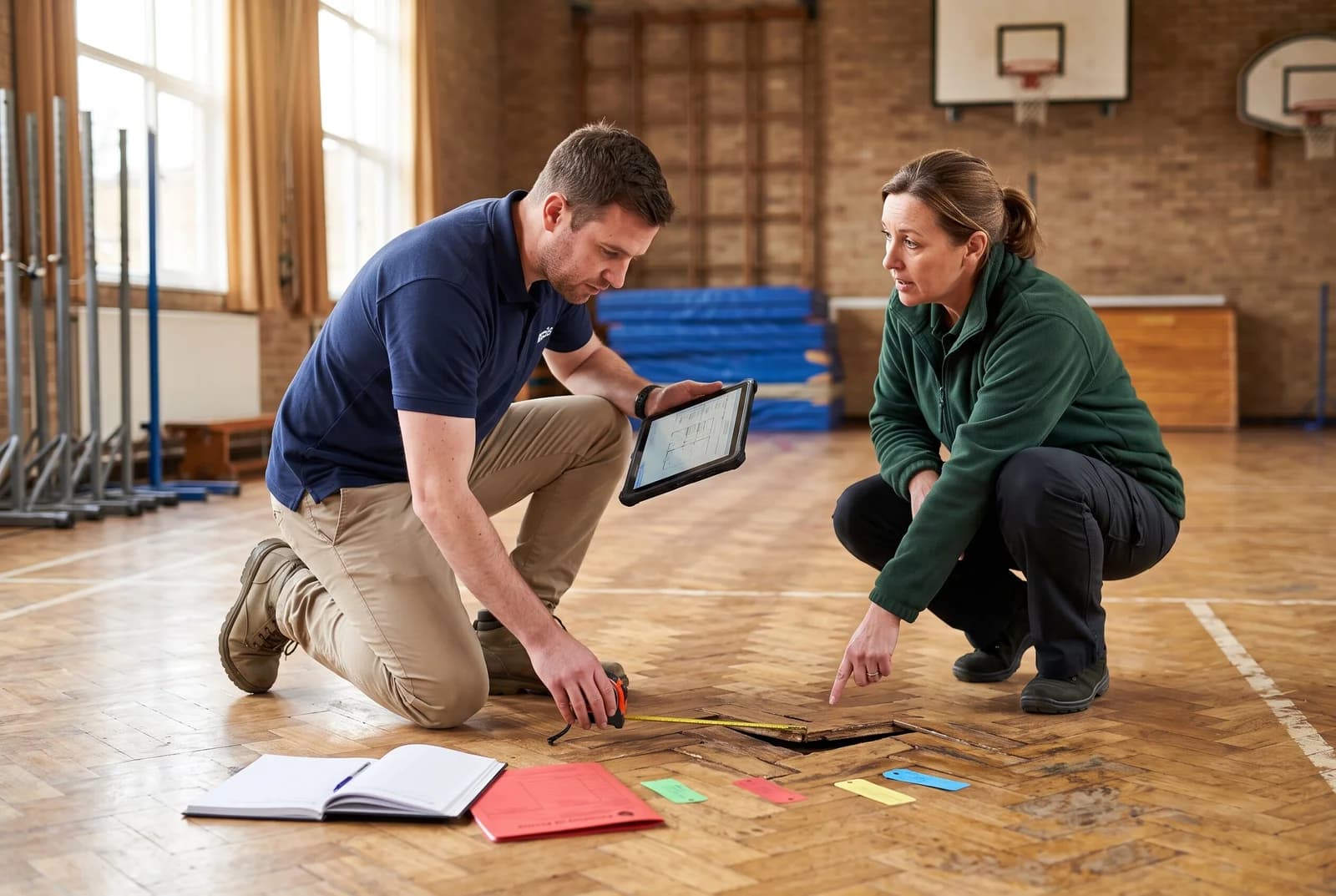
Understand how CIF can support academy sports hall flooring
The Condition Improvement Fund is intended to support eligible academies with capital works that address significant building condition, compliance or health and safety needs. A sports hall floor can therefore be relevant where its condition creates a material risk or prevents the facility from being used properly. You should present the project as a clearly evidenced estate need, rather than simply as a request for a newer playing surface. This is the foundation of CIF (Condition Improvement Fund) Success for Academy Sports Hall Flooring.
What the Condition Improvement Fund covers
CIF applications generally need to demonstrate that proposed work is necessary, prioritised and deliverable. For flooring, that means describing the defect or deterioration, its consequences, and the repair or replacement scope required to resolve it. Cosmetic preferences should not lead the case; the application should remain focused on condition, safety and continued educational use.
A useful starting point is a current school funding guide, which places CIF alongside other UK funding routes and stresses the importance of technical evidence. You should still check the current Department for Education guidance and timetable before committing to an application.
Academy eligibility and project suitability
Your academy trust should confirm eligibility for the relevant CIF round and consider whether the sports hall project fits the fund’s purpose. The strength of the proposal will depend on the condition evidence, the seriousness of the risk, the reasonableness of the scope and the credibility of the costs. A floor replacement with no documented condition problem is unlikely to make as persuasive a case as a project supported by inspection findings and a defined risk to users.
Bring the project into the trust’s wider estate process early. That allows you to explain how the sports hall ranks against roofs, heating, access, fire safety and other condition priorities, rather than presenting an isolated improvement.
When sports flooring may qualify as a condition issue
A sports floor may warrant consideration when it has become uneven, excessively worn, damaged by moisture, difficult to maintain or unsafe for normal activity. Persistent slipping, raised boards, failed joints, inadequate resilience or deterioration that affects court markings can all be relevant, but each point needs evidence. You should avoid assuming that age alone proves eligibility; the application must explain the present defect and its practical effect.
A professional inspection can distinguish between a surface that needs routine maintenance and a wider system failure requiring substantial works. That distinction helps keep the bid proportionate and avoids promising more than the evidence supports.
How flooring improvements support educational outcomes
The educational argument should be practical. A safe, usable hall supports PE lessons, examinations where relevant, clubs, fixtures and structured physical activity across the school day. If the hall is regularly closed, restricted or avoided because of its condition, explain the lost curriculum time and the effect on pupils, staff and community bookings.
You can strengthen this section by recording current closures, cancelled sessions and timetable compromises. The point is not to claim that a new floor solves every participation issue, but to show how a reliable facility removes a clear estate barrier to planned activity.
Build a strong CIF case for replacing a sports floor
A convincing replacement case tells a joined-up story: what is wrong, who is affected, why a lesser intervention is insufficient and what will happen if the work is postponed. Your narrative should be understandable to a reviewer who has never visited the academy. Use dated records, photographs, survey findings and cost information so that the urgency is visible rather than implied.

Identify safety, compliance and performance problems
Begin with observable problems and their consequences. Describe damaged areas, movement, surface wear, moisture staining, failed finishes, poor traction or inconsistent ball response where these have been established by inspection. If a standard or specification is relevant, state what has been checked and what the proposed system is expected to achieve; do not claim compliance without supporting documentation.
Complete Sports Flooring provides sports hall flooring installation, refurbishment and line marking, with surfaces described as compliant with EN14904 standards. If you seek specialist input, use it to clarify the existing condition and the appropriate remedial route, not to replace your own evidence.
Gather evidence from inspections, incidents and user feedback
Evidence is strongest when different sources point to the same issue. Combine a condition report with maintenance logs, accident or near-miss records, staff observations and feedback from PE teachers or regular users. Photographs should be dated and labelled by location, while a simple hall plan can show recurring defects and areas taken out of use.
Keep the records proportionate and factual. A short statement explaining when a problem occurs and what activity it affects can be more useful than a long collection of general complaints.
Explain the risks of delaying the project
Set out the likely consequences of doing nothing or carrying out only minor repairs. These may include increasing repair costs, continued restrictions on lessons, temporary closure, disruption to fixtures, or a greater risk of injury. Link each risk to evidence and distinguish between what is known, what is reasonably anticipated and what requires further investigation.
The delay argument should also consider timing. A project delivered during a planned closure may be manageable, while an unplanned failure during term time could create much greater operational disruption.
Link the proposal to the academy’s estate priorities
Show how the sports hall fits within the trust’s condition survey, asset management plan and planned maintenance priorities. Explain whether the floor is part of a wider refurbishment, whether adjacent defects must be addressed first and how the proposed work supports the useful life of the building. This makes the application look like considered estate management rather than a standalone wish list.
Your wording should make the decision clear: the academy needs a safe and serviceable hall, the existing condition prevents that, and the proposed work is the proportionate intervention.
Choose a sports flooring solution that meets CIF expectations
The proposed solution must respond to the actual hall, not just the preferred appearance of the finished floor. Consider the sports played, the intensity of use, the expected maintenance regime, the condition of the subfloor and the available installation window. A transparent specification also gives the funder confidence that your cost plan is based on a defined outcome.
Compare timber, vinyl and synthetic sports surfaces
Timber, vinyl and synthetic systems each have different performance, maintenance and installation characteristics. Timber may suit halls requiring a hardwood court system, while vinyl or other synthetic surfaces can be appropriate for multi-sport environments when specified for the intended use. The correct choice depends on the performance brief, existing construction and project budget, rather than material preference alone.
Ask for comparable information from suppliers and contractors: system build-up, preparation requirements, maintenance expectations, warranty conditions and relevant testing. This creates a fair basis for assessing value.
Match the specification to sporting activities and use levels
List the sports and activities that the hall must accommodate, including PE, clubs, fixtures and community use. Then consider whether the surface will receive daily high-volume traffic, wheeled equipment, specialist equipment or frequent line changes. A specification that works for one sport may not be suitable for a heavily shared hall, so the use schedule should guide the design.
Where basketball is central to the brief, basketball court flooring guidance can help you consider hardwood systems, subfloor preparation, moisture testing and precise game-line marking. Use such information to inform a project-specific specification, not to assume that one system suits every academy.
Consider shock absorption, slip resistance and line marking
Performance requirements should cover shock absorption, slip resistance, surface friction and the clarity and durability of line marking. These characteristics affect how confidently pupils move, stop and change direction, as well as how easily staff can maintain a safe playing environment. Your technical brief should identify the required performance criteria and the method of verification.
The lines should be planned with the sports programme in mind. Too many conflicting markings can reduce clarity, while poorly bonded or inaccurately positioned lines can undermine an otherwise sound installation.
Account for subfloor repairs, access and ancillary works
A replacement surface can fail if the underlying slab, screed or existing construction is not understood. Include moisture checks, level tolerances, local repairs, removal and disposal, skirtings, thresholds, protection and access arrangements in the scope where applicable. Confirm how materials will enter the building and how the hall will be protected from dust and other trades.
Your cost plan should make these associated works visible. Omitting them may produce an attractive initial figure but leave the academy exposed to variations once the old floor has been removed.
Prepare the technical and financial application evidence
The technical and financial parts of the application should reinforce each other. A survey should lead to a defined scope, the scope should support the specification, and the specification should explain the cost plan. Reviewers need to see that the requested amount is connected to the condition problem and that the academy understands what delivery will involve.

Obtain surveys and condition reports
Commission a suitable inspection before finalising the bid. The report should describe the floor construction where known, visible defects, likely causes, safety or usability implications and any limitations on the assessment. Moisture, level and adhesion checks may be relevant, especially where a new surface is proposed over or in place of an existing one.
Use photographs, marked-up drawings and test results selectively. Evidence is most useful when each item helps answer a funding question: what has failed, how serious is it and what work is required?
Develop an accurate scope of works
Write the scope in a sequence that mirrors delivery: preparation, removal, subfloor treatment, installation, line marking, testing, cleaning and handover. State what is included and excluded, and identify assumptions such as working hours, access, storage and the availability of a clear hall. This reduces ambiguity when quotations are obtained.
The scope should be detailed enough for like-for-like pricing without dictating an unsuitable product. Performance requirements and outcomes are often more useful than unexplained brand or material preferences.
Separate essential improvements from desirable upgrades
CIF evidence is clearer when essential condition works are separated from enhancements. Essential works might include removing a failed surface, repairing the subfloor, installing the specified sports system and reinstating safe markings. Desirable items could include aesthetic changes, additional storage or improvements that are useful but not necessary to resolve the documented defect.
This separation gives you a defensible fallback if the available funding is less than the full aspiration. It also demonstrates that the academy has tested the scope carefully.
Present whole-life costs, value for money and affordability
Compare more than the initial quotation. Set out expected maintenance, cleaning, refinishing or renewal requirements, and explain how the preferred option performs over its intended service life. Include realistic allowances for surveys, preparation, professional fees, VAT where applicable and contingency.
A simple comparison can help governors and reviewers understand the decision. Keep the figures tied to quotations or a clear estimating method, and explain any material difference between options.
| Option | Initial cost | Maintenance consideration | CIF relevance |
|---|---|---|---|
| Local repair and reseal | Lower | May require repeated intervention | Suitable only if condition evidence supports it |
| Partial replacement | Medium | Depends on interfaces and remaining floor | Requires a clear boundary and long-term rationale |
| Full system replacement | Higher | Provides a defined renewed system | Appropriate where widespread failure is evidenced |
The table is not a substitute for a survey, but it makes the value-for-money reasoning easier to follow. Your preferred option should be the one that resolves the condition issue at a proportionate whole-life cost, not automatically the cheapest or most extensive route.
Strengthen the application with professional project planning
Funding reviewers need confidence that the academy can move from approval to completion without avoidable uncertainty. Give the project a named owner, realistic milestones and a procurement route that reflects the trust’s governance requirements. Planning should also account for pupils, staff, contractors and other hall users from the beginning.
Set realistic costs and delivery milestones
Build the programme around surveys, approvals, procurement, lead times, preparation, installation, curing or acclimatisation where required, testing and handover. Avoid treating the installation period as the whole project. School holidays can provide a useful window, but you should confirm that the chosen sequence is achievable before presenting it as a commitment.
Allow time for decisions and approvals. A compressed programme with no allowance for clarification can be less credible than a slightly longer plan that shows how each stage will be controlled.
Demonstrate procurement and contractor readiness
Explain how quotations will be obtained, assessed and approved. Include the competence and relevant experience expected of the contractor, together with the information that will be issued to bidders. If a specialist sports flooring contractor has already reviewed the site, distinguish clearly between budget advice and a formal appointment.
Complete Sports Flooring describes installation and refurbishment of EN14904-compliant systems for educational institutions and leisure centres, with reference to ESFA and Sport England standards. Any contractor evidence in your application should be specific to the proposed works and supported by appropriate documentation.
Address safeguarding, access and operational disruption
A sports hall project takes place in a live educational environment, even when the building is closed to pupils. Set out how contractor access, deliveries, segregated work areas, emergency routes, dust, noise and communication will be managed. Include arrangements for neighbouring classrooms, shared entrances and any community bookings that must be moved.
A practical access plan can prevent delays that are unrelated to the flooring itself. Confirm who will release the hall, where materials can be stored and how the completed surface will be protected before reopening.
Include contingency planning for hidden subfloor defects
Removal works may reveal conditions that could not be fully assessed beforehand. Your plan should identify likely unknowns, explain how they will be investigated and state how variations will be authorised. A contingency is more credible when it is linked to a defined risk rather than added as an unexplained percentage.
Agree decision thresholds in advance. That allows the academy to respond quickly while preserving financial control and a clear audit trail.
Manage the flooring project after funding approval
Approval is a milestone, not the finish line. Before work starts, revisit the scope, survey findings, programme and budget so that the approved project and the delivered project remain aligned. Clear communication between the academy, trust, consultant and contractor is particularly valuable when the hall must reopen by a fixed date.
Confirm the specification before appointing the contractor
Check the final system build-up, performance requirements, line-marking schedule, colour choices, preparation assumptions and handover information. Resolve contradictions between drawings, quotations and schedules before the contract is signed. If a change is necessary, record its reason, cost and effect on the approved outcomes.
The specification should also identify the testing, cleaning and maintenance information that will be handed to the facilities team. This protects the investment after the contractor leaves.
Coordinate surveys, preparation and installation
Sequence the work so that investigations and preparatory repairs happen before the new surface is installed. Confirm moisture and environmental conditions where relevant, and agree who is responsible for accepting the substrate. Daily records, photographs and inspection points help you identify issues before they become concealed.
Complete Sports Flooring offers installation, refurbishment and line marking services, including sports hall flooring solutions described as EN14904 compliant. Whether you appoint this or another suitable contractor, retain evidence that the completed work matches the agreed technical brief.
Maintain sports hall access and minimise downtime
Plan closures, alternative PE spaces and communications around the installation programme. Protect the hall from premature traffic and do not reopen it until the specified surface has reached the required condition. Clear notices and a simple booking plan can prevent users from returning too early or damaging fresh work.
Keep a record of lost or relocated sessions. It helps you manage the immediate disruption and later demonstrate how the completed project restored reliable access.
Check workmanship, testing and practical completion
At completion, inspect the surface, joints, edges, markings, transitions and visible finish. Review test certificates, cleaning instructions, warranties, as-built information and outstanding defects. Practical completion should be based on agreed criteria rather than a quick visual walk-through alone.
Invite the facilities and PE teams to review the hall before sign-off. Their operational knowledge can identify issues with equipment movement, markings or access that may not be apparent during a contractor inspection.
Measure and communicate CIF success
Your close-out evidence should show what changed and how the academy is using the hall afterwards. Record the baseline condition, the intervention, the completion date and any agreed performance checks. This turns a completed capital project into useful estate information for governors, the trust and future applications.
Demonstrate improvements in safety and usability
Compare the documented pre-project risks with the post-completion position. Record areas returned to service, removed hazards, improved markings, fewer restrictions and the number of lessons or bookings restored where reliable data is available. Avoid claiming an improvement that has not been checked; a short post-occupancy review is better than an unsupported success statement.
Ask users to report practical issues during the first weeks. Their feedback can identify cleaning, equipment or access adjustments while the project is still fresh.
Record durability, maintenance and lifecycle benefits
Create a maintenance record covering cleaning methods, inspection frequency, remedial work and any manufacturer or contractor recommendations. Track defects and repairs over time, alongside usage levels and closure days. These records help you test whether the selected solution is performing as planned.
The benefit may be reduced disruption rather than a dramatic financial saving. A reliable maintenance history gives you a stronger basis for future lifecycle decisions.
Show benefits for pupils, staff and the wider community
Explain how the renewed hall supports the timetable, extracurricular activity, fixtures and community access. Where possible, use attendance, booking and timetable data to demonstrate restored capacity. Keep the claims proportionate and attribute outcomes to the completed project context rather than presenting them as guaranteed results.
A short case study with photographs, dates and user comments can communicate the difference clearly to trustees and stakeholders, provided permissions and safeguarding requirements are observed.
Capture evidence for future funding and estate planning
Store the final specification, invoices, certificates, photographs, warranties, maintenance plan and evaluation in the trust’s estate records. Note the original problem, the chosen remedy and any lessons about access, procurement or programming. This information will be valuable when the hall or another academy building reaches its next investment decision.
A disciplined close-out also helps you answer future questions about condition, value and project delivery. That is the practical measure of a successful CIF-funded flooring project.
Conclusion
A strong CIF flooring application is built on a clear condition problem, credible technical evidence and a delivery plan that respects the academy’s operational reality. When you connect safety, educational use, whole-life value and measurable outcomes, you give reviewers a coherent reason to support the work and give your academy a sound basis for managing the project.
—Quick answers
Frequently asked questions
Potentially, if the academy is eligible for the relevant funding round and can demonstrate that the floor presents a significant condition, compliance, health or safety need. Always check the current fund guidance and eligibility rules before preparing the application.
No. Age by itself is unlikely to establish the case. You should provide current evidence of deterioration, risk, loss of use or a need for substantial remedial work.
Useful evidence can include a professional condition report, photographs, inspection records, incident or near-miss information, user feedback, drawings, quotations and a clearly defined scope of works.
The application should request the proportionate solution supported by the evidence. If defects are localised, repair may be appropriate; if the system has widespread or fundamental failure, replacement may be more defensible.
Base the decision on the sports programme, traffic levels, performance requirements, subfloor condition, maintenance capacity, installation constraints and whole-life cost. Material appearance should be secondary to suitability and evidence.
Schedule work during a planned closure where possible, agree delivery and storage arrangements, provide alternative spaces for affected activities and keep the hall closed until the surface is ready for use.
Keep the final specification, test results, completion records, warranties, maintenance instructions, photographs, invoices and a short evaluation of safety, usability and operational benefits.