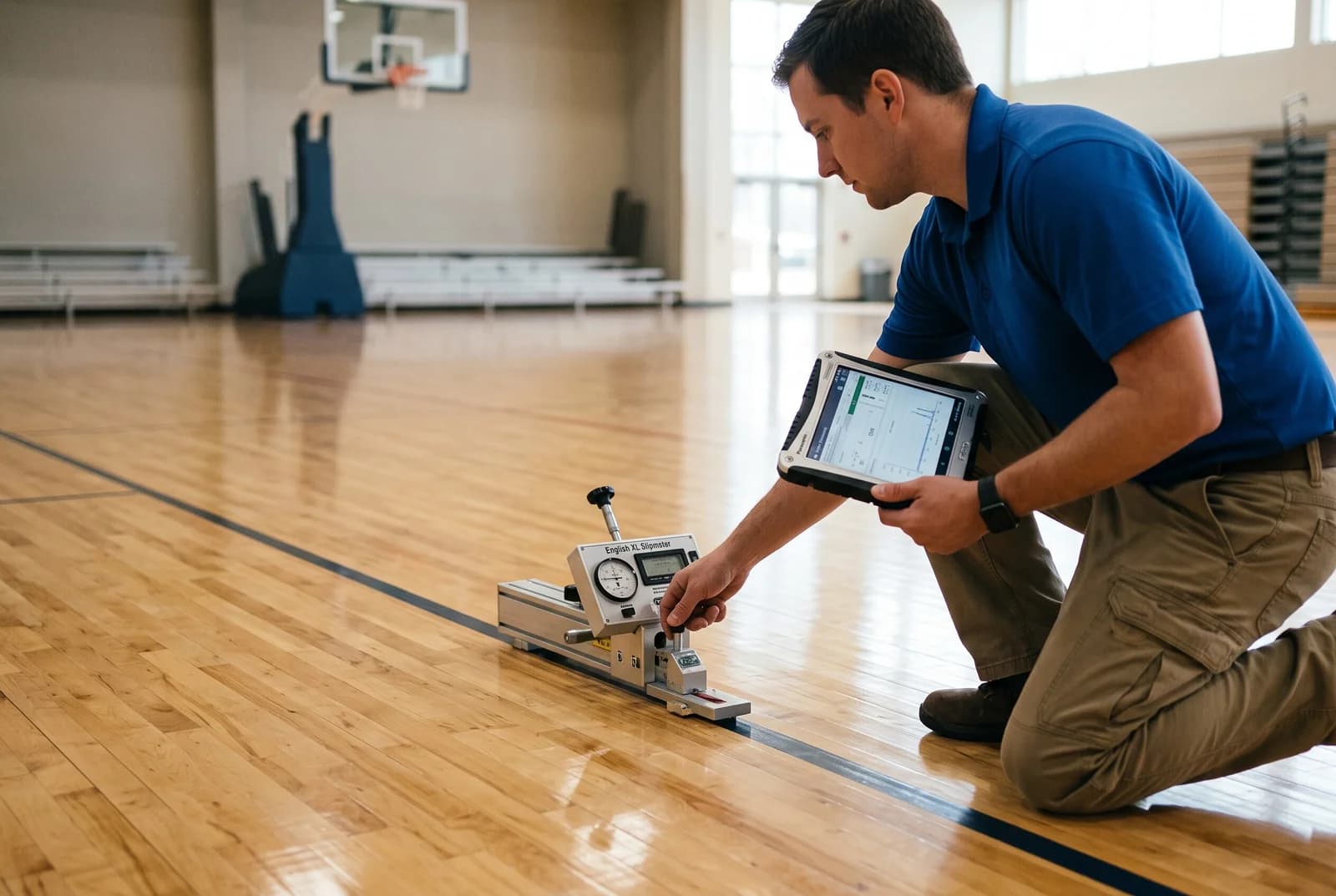
What surface friction testing measures on a basketball court
Surface friction testing examines how much resistance exists between a player’s footwear and the court. It is one part of a wider assessment that can also include shock absorption, ball bounce, finish condition and structural performance. For facility managers, the aim is not simply to obtain a number, but to understand whether movement feels controlled and consistent. That makes Surface Friction Testing: Ensuring Safety in Competitive Basketball Facilities a practical management issue rather than a purely technical exercise.
The relationship between traction, slip resistance and player control
Traction is the grip available when you accelerate, brake or push away from the floor. Slip resistance describes the surface’s ability to resist unwanted sliding under a defined test condition. Player control depends on both, as well as footwear, movement technique and the force being applied. A reading should therefore be considered alongside how the court behaves during realistic basketball actions.
Static and dynamic friction explained
Static friction concerns the force needed to start movement between two contacting surfaces. Dynamic, or kinetic, friction concerns resistance while sliding is already taking place. A court may feel secure during a planted stance but behave differently during a fast stop, so a useful testing programme needs a defined method rather than informal impressions alone.
How friction affects stopping, pivoting and changing direction
Basketball places repeated demands on the surface: short sprints, sudden deceleration, one-foot pivots and lateral changes of direction. Suitable friction helps you transfer force without an unexpected slide, while consistency lets you repeat those actions across the court. The key question is whether the floor supports controlled movement in busy areas such as the key, baseline and common approach paths.
Why excessively high or low friction creates safety concerns
Low friction can increase the likelihood of slipping, particularly when dust or moisture is present. Excessively high friction can also be problematic if footwear catches abruptly instead of releasing naturally during a turn. You should avoid treating “more grip” as automatically safer; balanced surface behaviour is the more useful objective.
Why friction testing matters in competitive basketball facilities
A competitive facility may host matches, training sessions, school lessons and community use within the same week. That varied schedule can expose the floor to different footwear, cleaning routines and patterns of traffic. Testing gives you evidence when a surface feels different, and it supports decisions before a minor issue becomes an incident or a costly closure. It also provides a common language for facilities teams, contractors and flooring manufacturers.

Preventing slips, trips and non-contact injuries
A friction test cannot predict every injury, and it should never replace inspection of the floor or the wider venue. It can, however, reveal a surface that has become unusually slick, contaminated or inconsistent. When readings are combined with incident records and staff observations, you have a stronger basis for isolating hazards and deciding whether the court needs cleaning, restricted use or specialist attention.
Supporting consistent performance across the playing area
Players adapt quickly to a court that behaves consistently, but a sudden change between zones can disrupt foot placement and confidence. Sample points should include high-use areas and quieter margins so that you can compare the playing surface rather than relying on a single average. A professional flooring specification should consider surface friction alongside other performance requirements; this sports flooring specification guide provides useful context on compliance and performance criteria.
Meeting expectations for professional and community venues
Professional venues may have formal inspection requirements, while schools and leisure centres still need a defensible approach to safety. Your method should reflect the venue’s use, the flooring system installed and the guidance supplied with it. For London education and leisure facilities, Complete Sports Flooring works with EN14904-compliant sports flooring systems and coordinates projects around operational requirements; the testing record remains part of your facility’s own management process.
Connecting friction results with flooring maintenance and warranties
A result is more useful when it can be traced to the surface’s age, finish, cleaning history and maintenance work. Keep records of installation documents, product information, repairs and previous readings. If a warranty question arises, a dated sequence of measurements and photographs can help show what changed and when, although warranty decisions remain subject to the relevant contract and manufacturer’s terms.
Factors that influence basketball court friction
Friction is not a fixed characteristic that exists independently of the court’s condition. The flooring material, coating, cleanliness, climate and footwear all influence the interaction at the point of contact. Even equipment movement can introduce fine contamination or alter a worn finish. Understanding these influences helps you interpret a reading sensibly instead of blaming the flooring system too quickly.
Hardwood, synthetic and multi-purpose sports flooring
Hardwood, synthetic and multi-purpose floors have different surface constructions and maintenance requirements. A solid hardwood court may respond differently from a synthetic system, while a multi-use hall can experience wear from activities beyond basketball. You should identify the installed system and follow its technical information before selecting a testing method or recommending a treatment.
Surface coatings, finishes and wear patterns
A coating protects the floor and affects the texture encountered by footwear. Repeated movement, chair storage, staging or localised cleaning can gradually create areas that differ from the rest of the court. Gloss alone is not a reliable indicator of friction, so visual appearance should prompt investigation rather than serve as a substitute for measurement.
Dust, moisture, cleaning products and contamination
Dust can reduce predictable contact, while moisture may make a surface temporarily slippery. Residue from an unsuitable cleaning product can also change the feel of the finish or attract more dirt. Before testing, document recent cleaning and any visible contamination; otherwise you may record a temporary condition without understanding its cause.
Temperature, humidity and seasonal changes
Indoor conditions vary with weather, ventilation, heating and the number of people using the hall. Timber can respond to changes in moisture and humidity, and cleaning may dry at different rates across a large space. Record temperature and humidity with your results so that later comparisons are made under reasonably similar conditions.
Footwear, court markings and equipment movement
The sole compound, tread and cleanliness of footwear influence traction just as the floor does. Court markings, decals and transitions between materials may also create local changes, particularly where a player plants a foot near a line. Retractable seating, goals and other equipment should be moved carefully and checked for debris or damage before the next session.
How to carry out basketball court friction testing
Reliable testing begins with a defined procedure. You need to know which areas matter, what equipment is being used and which conditions could affect the result. The method should be repeatable enough for you to compare readings over time, but practical enough to fit around bookings and venue access. If the floor is being installed or refurbished, a specialist survey and documented handover can make later checks easier.

Preparing the court and defining test locations
Close the court to normal activity, remove movable equipment and inspect the surface first. Mark a simple location plan covering the key, baselines, sidelines, centre area and any visibly worn or contaminated zone. Clean or test according to your chosen procedure, but record which condition was measured so the result is not separated from its context.
Selecting calibrated friction testing equipment
Use equipment suitable for sports flooring and maintain its calibration in line with the manufacturer’s instructions. Check the contact material, load arrangement and measurement range before starting. A calibration certificate, equipment identifier and operator’s name should appear in the test record, allowing another person to understand how the readings were produced.
Controlling test speed, load and environmental conditions
Small changes in speed, applied load or contact material can affect a friction result. Keep these variables consistent and record temperature, humidity, cleaning status and the time since the court was last used. Do not compare two sets of numbers as though they were equivalent if the test method or conditions changed substantially.
Taking representative readings across high-use zones
High-use areas deserve attention because repeated stopping and pivoting can change the finish sooner than quieter parts of the court. Take more than one reading where practical and repeat any result that appears unusual. A useful sample includes both expected wear zones and reference areas that represent normal court condition.
Recording results for repeatable comparisons
A clear record should connect every reading to a location, date, operator, instrument and environmental condition. Note the surface type, cleaning products used, visible defects and any restrictions placed on the court. For larger venues, an agreed location map prevents each inspection from quietly moving to a different set of points.
How to interpret and document test results
Numbers need context before they can guide a decision. Start with the test method, then consider the flooring specification, the venue’s use and any relevant manufacturer or governing-body guidance. Avoid presenting a single result as a universal pass or fail when the applicable requirement has not been confirmed. Good documentation makes uncertainty visible and shows what you plan to do next.
Comparing readings with manufacturer and governing-body guidance
Use the installed flooring system’s technical documents and the requirements that apply to your venue. EN 14904 may form part of the specification, but the correct interpretation depends on the tested characteristic, method and project documentation. If you are planning new work, Complete Sports Flooring can provide sports flooring installation and refurbishment services with attention to EN14904-compliant systems; existing-court testing should still be assessed against the documents for that particular floor.
Identifying inconsistent friction between court areas
An average can conceal a meaningful difference between two locations. Compare readings by zone and look for repeated patterns rather than reacting to one isolated value. A lower result beside a frequently used baseline, for example, warrants a different investigation from a single low reading in an otherwise uniform court.
Distinguishing isolated defects from wider surface problems
Inspect the surrounding finish, joints, markings and subfloor symptoms when a local result seems unusual. Contamination, a damaged coating or a transition detail may explain a small area, while similar readings across several zones suggest a broader maintenance or surface issue. Repeat testing after the suspected cause has been addressed before deciding that a full resurfacing is necessary.
Creating a clear inspection report with photographs and measurements
Your report should be understandable to someone who was not present on the day. Include a court plan, test method, equipment details, readings, environmental conditions, photographs and notes about use or cleaning. A short narrative explaining the observed pattern is often more useful than a page of unexplained figures.
Establishing thresholds for monitoring and corrective action
Set action levels with reference to the relevant specification, professional advice and your venue’s risk assessment. You might define a normal monitoring range, a trigger for repeat testing and a level requiring restricted use or remedial work. Review those thresholds when the flooring system, test method or operational risk changes.
Improving and maintaining court surface safety
Testing is valuable because it leads to practical action. Sometimes the answer is a revised cleaning routine; sometimes it is a local repair or a complete refurbishment. The appropriate response depends on the cause, the extent of the change and the condition of the underlying system. Avoid aggressive treatments that improve a short-term feel while shortening the finish’s useful life.
Adjusting cleaning methods without damaging the finish
Use cleaning products and equipment approved for the installed flooring system. Excess water, abrasive pads and unapproved chemicals can affect timber finishes and leave residues. Train staff to follow measured dilution, correct drying times and a consistent sequence, then verify the result through observation and, where necessary, repeat friction testing.
Removing contamination and addressing localised wear
Begin with the least disruptive suitable intervention. Remove dust and residue, investigate the source of moisture or dirt, and isolate any area where the finish is visibly damaged. If a local repair is attempted, test after the surface has cured and compare the repaired area with nearby readings.
Repairing, recoating or resurfacing the playing surface
A worn finish may require professional recoating, while deeper damage or widespread inconsistency may justify resurfacing. The decision should account for the floor’s construction, moisture condition, usage pattern and future bookings. Complete Sports Flooring’s refurbishment work is relevant where a facility needs a planned intervention, but the scope should follow a site assessment rather than a generic recommendation.
Scheduling routine friction checks and post-maintenance tests
Build checks into the maintenance calendar and repeat them after significant cleaning changes, recoating, repairs or refurbishment. Schedule work during closures or school holidays where possible, while allowing enough time for curing, ventilation and verification. Post-maintenance readings give you evidence that the court has returned to the intended condition before regular play resumes.
Training staff to recognise changing traction conditions
Staff may notice a slippery patch, unusual squeaking or a change in how footwear responds before a formal inspection takes place. Give them a simple reporting route and explain when to close or cordon an area. A short log of observations, cleaning activity and incidents can make later technical testing far more informative.
Building a practical friction testing and compliance programme
A programme works best when it is proportionate to the venue and easy to repeat. You do not need a complicated system to begin; you need clear ownership, a consistent method and records that survive staff changes. Combine surface readings with visual, structural and operational information. That approach helps you manage risk while keeping the court available for the people who depend on it.
Assigning responsibilities to facility and maintenance teams
Name the person who schedules tests, the person who prepares the court and the person who reviews findings. Contractors should receive the location plan and reporting template before work starts. For schools and leisure centres, responsibilities should also cover communication with booking teams so that testing and remedial work do not appear as unexplained cancellations.
Combining friction tests with visual and structural inspections
Friction is only one element of court performance. Inspect boards, joints, line markings, moisture indicators, surface damage, transitions and surrounding access routes at the same time. A combined inspection is more likely to identify the cause of a change and less likely to encourage an expensive response to a symptom.
Using trend data to plan maintenance budgets
Store readings in a format that lets you compare location, date and condition. The trend may be gradual deterioration, a sudden change after a cleaning product, or a persistent difference between two zones. These patterns can support planned budget requests and reduce the temptation to wait until urgent work disrupts fixtures.
| Record element | Why it matters | Example use |
|---|---|---|
| Test location | Shows where change occurs | Compare baseline and key |
| Reading and method | Makes results comparable | Review repeat tests |
| Temperature and humidity | Adds environmental context | Explain seasonal variation |
| Cleaning or repair history | Connects cause and effect | Assess post-maintenance change |
| Photograph and action | Preserves evidence | Track a local defect |
The table is a useful minimum for a repeatable record, not a replacement for professional judgement. Add the flooring system, instrument details and reviewer’s decision where relevant. Over time, this information can show whether routine maintenance is working or whether the surface needs a larger intervention.
Reviewing procedures after incidents or major refurbishment
After an incident, review the immediate conditions, recent cleaning, footwear, court access and the inspection record. Following major refurbishment, confirm that the completed surface matches the specified system and that post-work checks are recorded before reopening. Complete Sports Flooring’s installation approach includes attention to site conditions and project sign-off, which can help create a useful handover trail for future facility management.
Communicating findings to coaches, officials and facility users
Explain findings in practical terms: which area is affected, what action is being taken and when the court will be available. Coaches and officials can provide valuable feedback on movement and changing conditions, but their observations should complement measured checks. Clear communication builds confidence without overstating what any single friction result can prove.
Conclusion
A basketball court’s friction affects confidence, control and safe movement, but it changes with wear, contamination, climate and use. By testing representative areas, recording conditions and linking results to maintenance decisions, you can manage the surface with far greater certainty. A consistent programme protects court availability while supporting the standards and expectations of competitive, educational and community facilities.
—Quick answers
Frequently asked questions
It is a controlled assessment of resistance between a test contact and the court surface, used to understand traction and consistency. It should be interpreted alongside the floor specification, condition and intended use.
The suitable frequency depends on usage, flooring type, maintenance activity and risk assessment. Routine checks should be supplemented after contamination, incidents, repairs, recoating or refurbishment.
No. Visual inspection can identify wear, residue, damage and other warning signs, but it cannot reliably quantify surface resistance. The two approaches work best together.
Dust, moisture, cleaning residue, worn finishes, unsuitable products and changes in footwear can all affect traction. Environmental conditions and high-use patterns may also contribute.
No. Very high friction can prevent natural foot release during pivots and turns. The objective is suitable, consistent resistance for the flooring system and its intended sporting use.
Include the date, locations, method, equipment, readings, environmental conditions, surface condition, photographs and any recommended action. Recording recent cleaning or repair work adds useful context.
A responsible facility manager can begin the review, but unusual, persistent or safety-critical results should be assessed by a suitably competent flooring or sports-surface professional. Restricting use may be appropriate while the cause is investigated.